
16-09-02 -- Summary Of Essay Nine Part Two:
How Petty Bourgeois Theorists And Their Theory, Dialectical Materialism, Have Damaged Marxism
In what follows, I take the results of other Essays at this site -- particularly Essays Nine Part One and Ten Part One -- for granted.
If you are using Internet Explorer 10 (or later), you might find some of the links I have used won't work properly unless you switch to 'Compatibility View' (in the Tools Menu); for IE11 select 'Compatibility View Settings' and then add this site (anti-dialectics.co.uk). Microsoft's new browser, Edge, automatically renders these links compatible; Windows 10 does likewise.
However, if you are using Windows 10, Microsoft's browsers, IE11 and Edge, unfortunately appear to colour these links somewhat erratically. They are meant to be dark blue, but those two browsers render them intermittently mid-blue, light blue, yellow, purple and red!
Firefox and Chrome reproduce them correctly.
Any readers who find even this summary a little too long, I have posted a much shorter version of some of its main points here.
~~~~~~oOo~~~~~~
This is an Introductory article written for those who find the main Essays at this site either too long or too difficult. It doesn't pretend to be comprehensive since it is simply a summary of the core ideas presented at this site. Most of the supporting evidence and argument found in each of the main Essays has been omitted. Anyone wanting more details, or who would like to examine my arguments and evidence in full, should consult the Essay for which this is a précis. [That can be found here.]
Readers new to my ideas would be wrong conclude from the title of this Essay (or, indeed, this site) that it is all about DM and the effect it has had on Marxism. This Essay and this site are just as focussed on the class origin of the founders of our movement, and of those who control its ideas today, as it is on DM. [See the Abstract. Hence, it breaks entirely new ground -- as anyone who reads on will soon discover --, providing for the first time an HM explanation why our movement so often fails and why much that we on the Revolutionary Left touch sooner-or-later becomes corrupted, fragmented, and then turns to dust.
However, nothing said here is aimed at undermining Historical Materialism [HM] -- a theory I fully accept -- or, for that matter, revolutionary socialism. My aim is to (i) Assist in the scientific development of Marxism by helping to demolish a dogma that has in my opinion seriously damaged our movement from its inception: Dialectical Materialism [DM] -- or, in its more political form, 'Materialist Dialectics' [MD] --, (ii) Expose the links between this theory and the class origin and position of those who 'lead' our movement, and (iii) Reveal how this combination has helped cripple revolutionary socialism.
On the difference between HM and DM/MD as I see it, see here.
~~~~~~oOo~~~~~~
The material presented below was largely written before (1) The 2007/08 crisis in UK-Respect developed, (2) The crises that have blown up in the intervening years, and (3) The crisis which is building inside the UK-SWP right now (i.e., as of January-April 2013).
[On the first two of the above, see for example, here, here, here, here, here, here, and here. I have added only a handful of comments about the latest crisis in the UK-SWP since there is very little solid information about it yet, as opposed page after page on the internet of rumour, speculation, gossip, exaggeration, slander, innuendo, and downright lies. What I have said can be found here, here, and here.]
Nevertheless, these untoward events were predictable given the things you will read below, as are the many more we will witness on the far-left in the coming years -- if we fail to learn the right lessons.
~~~~~~oOo~~~~~~
It is worth pointing out that phrases like "ruling-class theory", "ruling-class view of reality", and "ruling-class ideology" (used at this site in connection with Traditional Philosophy and DM) aren't meant to imply that all or even most members of various ruling-classes actually invented this way of thinking or of seeing the world (although some of them did -- for example, Heraclitus, Plato, Cicero and Marcus Aurelius). They are intended to highlight theories (or "ruling ideas") that are conducive to, or which rationalise, the interests of the various ruling-classes history has inflicted on humanity, whoever invents them. Up until recently this dogmatic approach to knowledge had almost invariably been promoted by thinkers who either relied on ruling-class patronage, or who, in one capacity or another helped run the system for the elite.
However, this will become the central topic of Parts Two and Three of Essay Twelve (when they are published; until then, the reader is directed here, here, and here, for further details.)
[Exactly how and why this applies to DM will, of course, be explained in the other Essays published at this site (especially here, here, and here). In addition to the three links in the previous paragraph, I have summarised the argument (but this time aimed at absolute beginners!) here.]
A summary of my overall objections to DM/MD can be found here; the reason why I embarked on this project (back in 1998) is explained here. Anyone puzzled by the unremittingly hostile tone I have adopted toward DM/MD should read this first for an explanation.
In what follows I am dealing with all forms of Dialectical Marxism and not just with Dialectical Trotskyism (or even with the ideology of the UK-SWP!). Some of the things I have to say therefore apply to all forms of Dialectical Marxism, while all of them apply to some.
[On the almost identical appeal to, and use of use of, DM/MD by all wings of Dialectical Marxism (this is aimed at countering the allegation that Stalinists, for example, use a 'wooden' and 'dogmatic' form of the dialectic -- in fact, they are all wooden and dogmatic), see here and here.]
Finally, since I am challenging deeply entrenched ideas, it isn't possible to give a clear, comprehensive or coherent summary of my overall analysis in a handful of paragraphs. In which case, the reader's indulgence is required while I continue to develop the argument -- even in précis form!
Readers who find my arguments below superficial and/or unconvincing need to remember that this is a brief summary of a very much longer Essay, the equivalent of a 450 page book!
[Latest Update: 27/01/21.]
Anyone using these links must remember that they will be skipping past supporting argument and evidence set out in earlier sections.
If your Firewall/Browser has a pop-up blocker, you will need to press the "Ctrl" key at the same time or these and the other links won't work!
I have adjusted the font size used at this site to ensure that even those with impaired vision can read what I have to say. However, if the text is still either too big or too small for you, please adjust your browser settings!
(1) Introduction
(a) Abstract
2) The Dialectics Of Consolation
(a) In Defeat, Don't Organise, Speculate
(e) Salvation Through Good Works
(a) Social Atoms Trying To Act Like Molecules
(b) Divide And Rule
(c) 'Building The Party' -- Through Constant Splits
(d) All Hale The Great Splitter
(e) The Road To Dialectical Damascus
(f) Defeat And Dialectical Druggies
(g) Disaster Central
(i) Social Psychology Doesn't Apply To Dialecticians
(4) Case Studies
Summary Of My Main Objections To Dialectical Materialism
Abbreviations Used At This Site
In this Second Part of Essay Nine I hope to show that:
(A) The class origin, education, and socialisation of leading Marxists -- both in previous generations and contemporaneously -- predisposed them into viewing the world in a particular, but thoroughly traditional, way.
(B) The recruitment of such comrades into Marxism from non-working class backgrounds, alongside their subsequent career as 'professional revolutionaries', is largely responsible for the deeply sectarian nature of revolutionary socialism.
(C) Sectarianism isn't caused -- but it was seriously aggravated -- by a theory imported into the workers' movement from the work of that Christian and Hermetic Mystic, Hegel. This theory subsequently became Dialectical Materialism/'Materialist Dialectics' [DM/MD]. [Henceforth I will simply refer to DM, but readers should assume I mean either or both of these manifestations of Hegel's ideas (upside down or 'the right way up').] This theory became a handy vehicle for accusing practically every other Marxist, and Party, of not "understanding" or of "misusing" dialectics, which only succeeded in aggravating the petty-bourgeois sectarianism endemic in the movement.
(D) DM became useful in other ways, too. Because this theory teaches that 'appearances' are 'contradicted' by underlying 'essences' -- i.e., how the world appears to be is the opposite of the way it really is -- it has functioned as a source of consolation for the fact that Dialectical Marxism has been so spectacularly unsuccessful for so long. It is able to do so it convinces dialecticians that the history of Marxism is the opposite of the way it looks -- i.e., that it is in fact a success story because it has been "tested in practice", when history delivers a very clear, contrary verdict.
(E) DM teaches that nature and society are 'contradictory'; in which case a scientific view the world must be contradictory, too. Because of this, DM can be, and has been used to derive anything a theorist or party finds expedient and its opposite -- often this trick is performed by the very same theorist in the same article or speech. Hence, this theory has been used to sell counter-revolutionary and anti-Marxist ideas to party cadres, justifying political U-turns, substitutionism, class collaboration, corruption, and anti-democratic party structures and procedures as a result.
Finally, it is important to add that I am not blaming the long-term failure of Dialectical Marxism solely on the acceptance of Hegelian and Hermetic ideas that dialecticians have imported into the movement.
What is being claimed, however, is that adherence to this 'theory' is one of the subjective reasons why Dialectical Marxism has become a bye-word for failure. [I have entered into the subjective side of this this topic in much more detail, here.]
While there are also other, objective reasons why the class enemy still runs the planet, since revolutions require militants with ideas in their heads, this 'theory' must take some of the blame.
So, it is alleged here that dialectics has been an important contributory factor. However, the class origin and class position of those who have led our movement and who control its ideas are equally, if not more, to blame.
All of the above, and much else besides, will be substantiated fully in Essay Nine Part Two; the main points are merely summarised below.
~~~~~~oOo~~~~~~
It is important to note from the start that the argument advanced in this Essay isn't as follows: (a) DM is false because it has helped ruin Marxism, but rather: (b) Since DM makes no sense, it is no big surprise that it has helped ruin Marxism.
In Part One of this Essay it was argued that:
(1) DM has to be substituted into workers' heads from the "outside" since it is based on an incomprehensible and incoherent form of ruling-class ideology;
(2) DM depends neither on the experience of the Party nor that of the working class (because of point (1), above), and therefore that:
(3) DM constitutes the ideology of substitutionist elements in the workers' and revolutionary movement.
(4) This theory also helps render dialectically-dominated parties and comrades insufferably arrogant (in a way that has also worked for many others throughout history -- those who think they alone have a true theory of everything, and that history, or 'God', is working solely through them), which means they almost invariably treat others in the movement (or even those in the same party) with dismissive contempt, studied indifference, and sometimes even callous inhumanity. Again, if you are carriers and purveyors of 'cosmic truth', anyone who disagrees with you deserves ostracism or expulsion, at best, imprisonment or death, at worst. This 'dialectical' frame-of-mind also helps motivate the idea that The Party (or The Leader) is infallible, the sole fountain of truth.
As I also pointed out in Part One:
Herein lies the source of much of the corruption we see in Dialectical Marxism. If your core theory allows you to justify anything you like and its opposite (since it glories in contradiction), then your party can be as undemocratic as you please while you argue that it is 'dialectically' the opposite and is the very epitome of democratic accountability. It will also 'allow' you to claim that your party is in the vanguard of the fight against all forms of oppression, all the while covering up, ignoring, justifying, rationalising, excusing or explaining away sexual abuse and rape in that very same party. After all, if you are used to 'thinking dialectically', an extra contradiction or two is simply more grist to the dialectical mill!
And if you complain, well you just don't 'understand' dialectics...
In Defeat, Don't Organise -- Speculate!
As it turns out, the reason why the majority of revolutionaries not only willingly accept the ruling-class ideas encapsulated in DM, but cling to them like terminally-insecure limpets, is connected with the following four inter-related considerations:
(1) Marx's analysis of the nature and origin of religious affectation in alienation.
(2) Lenin's warning that revolutionaries may sometimes respond to defeat and disappointment by turning to Idealism and Mysticism.
(3) The biographies and class origin of all leading Marxists and DM-theorists.
(4) The fact that this theory not only helps mask the long-term failure of Dialectical Marxism, it provides a source of consolation for unrealised expectations and constantly dashed hopes.
These controversial allegations will now be explained more fully and then defended. How they have helped corrupt Dialectical Marxism will also be explained.
First, Marxists are well aware that there are those in the workers' movement who will seek consolation in the face of defeat, and that they often find this in Mysticism and Idealism.
Fortunately, Lenin himself supplied a materialist answer to this conundrum (i.e., why hard-headed revolutionaries and atheists seek consolation in the face of defeat), and John Rees very helpfully outlined it for us when he depicted the period following the failed 1905 Russian revolution in the following terms:
"[T]he defeat of the 1905 revolution, like all such defeats, carried confusion and demoralisation into the ranks of the revolutionaries…. The forward rush of the revolution had helped unite the leadership…on strategic questions and so…intellectual differences could be left to private disagreement. But when defeat magnifies every tactical disagreement, forcing revolutionaries to derive fresh strategies from a re-examination of the fundamentals of Marxism, theoretical differences were bound to become important. As Tony Cliff explains:
'With politics apparently failing to overcome the horrors of the Tsarist regime, escape into the realm of philosophical speculation became the fashion….'
"Philosophical fashion took a subjectivist, personal, and sometimes religious turn…. Bogdanov drew inspiration from the theories of physicist Ernst Mach and philosopher Richard Avenarius…. [Mach retreated] from Kant's ambiguous idealism to the pure idealism of Berkeley and Hume….
"It was indeed Mach and Bogdanov's 'ignorance of dialectics' that allowed them to 'slip into idealism.' Lenin was right to highlight the link between Bogdanov's adoption of idealism and his failure to react correctly to the downturn in the level of the struggle in Russia." [Rees (1998), pp.173-79, quoting Cliff (1975), p.290. Bold emphases added. Quotation marks altered to conform to the conventions adopted at this site. (However, I can find no reference to "dialectics" in Cliff's book.)]
From this, it is quite clear that the experience of defeat (compounded by the lack of a democratic or materialist input from a mass working-class movement) re-focused prominent revolutionaries in the direction of Idealism and a mystical explanation for the serious set-backs Russian Marxists had experienced post-1905. Plainly, this turn provided these comrades with some form of consolation -- just as Marx had alleged of religious belief pure and simple, and, indeed, as Lenin himself implied.
But, there is another outcome that Rees and others failed to notice: this major set-back also turned Lenin toward philosophy and dialectics. These were subjects which he had largely (but not entirely) ignored up until then. After 1905, they began to dominate his thought. So, while Bogdanov and the rest turned to Mach, Berkeley, Subjective Idealism and other assorted irrationalisms, it is equally clear that Lenin looked to Hegel and 'objective' Mysticism to counter their arguments, motivate his own analysis and provide himself with some level of consolation.
So, Lenin's warning shows that revolutionaries themselves aren't immune to the pressures that lead human beings in general to seek consolation in order to counteract disappointment, demoralisation and alienation. As we have seen, Lenin was well aware that alien-class ideas, which 'satisfy' such needs, could enter the workers' movement from the "outside" at certain times.
However, those like Cliff and Rees who point such things out are themselves immune from the baleful influence exerted by the metaphysical black hole represented by this consoling ideology only if they can show that they are above the material constraints social life places on everyone else --, which, clearly, they aren't, and hence they can't.
As we will see, dialecticians have indeed sought consolation in times of defeat -- something they regularly experience. They do this by turning to a theory that reassures them with comforting words: that Dialectical Marxism isn't a long-term failure but is, on the contrary, a ringing success -- because it has been 'tested in practice'. DM is uniquely well-placed in this regard since it teaches that appearances are "contradicted" by 'underlying realities'. Hence, even though Dialectical Marxism might appear to be an abject and long-term failure, to those with a well-focussed dialectical 'third eye', it is the very epitome of success.
Or, it is about to be, any day soon. Just you wait...
[Essay Ten Part One is devoted to substantiating these seemingly controversial accusations.]
There is in fact no reasoning with pathological optimism like this since it depends on a level of dislocation from reality that would even shame a coma victim -- as anyone who has tried to slap some materialist good sense into these dialectical day-dreamers can well attest. The fact that we have witnessed little other than defeat, disaster, retreat and set-back since the 1920s is brushed off as a mere blip. The dialectic will "spiral" back to save the day, under the ever watchful eye of the NON.
[NON = Negation of the Negation.]
While revolutionaries who have been recruited directly from the working-class appear to be less susceptible to this intellectual malaise, those entering our movement from other classes, it seems, are highly vulnerable in this regard. [Why that is so will be explained presently.] Unfortunately, the authors of the DM-classics weren't workers -- and neither were the Hermetic Philosophers upon whose ideas they relied. And, in general, if we are honest, neither are those who lead the revolutionary movement today and who thus control its ideas.
DM provides this professional layer with a form of intellectual consolation, which, among other things, reassures them that history (if not the entire dialectic of reality) is on their side -- despite the many material facts which every day openly contradict this rosy picture. DM now 'allows' these individuals to account for, and then reconfigure, their experience of constant defeat, rejection and failure as its opposite -- that is, as success in disguise, or, once more, as success about to happen any day soon.
In which case, and paradoxically, recalcitrant reality doesn't refute dialectics, it confirms it!
Dialectics thus insulates militant minds from the unwelcome fact that their Idealist theory is refuted almost on a daily basis by disconfirming 'appearances'. That being so, there is for them no pressing need to question their core theory; after all, 'practice' confirms it!
So, the theory that helps engineer this disconnection is the very same theory that tells those whose brains it has colonised that nothing need be done to rectify the situation since there is in fact no problem that needs addressing!
Failure, even if it is so much as acknowledged, is blamed on 'objective' factors, on a 'failure of leadership' in those other 'sects' -- who, oddly enough, don't have the right 'dialectical method', even though those on the receiving end of that accusatory finger say more-or-less the same about their accusers in return.
Material reality is thus inverted so that in an Ideal Form it now conforms to theory. Dialecticians ignore or explain away whatever fails to fit the Hermetic world-view that had been inflicted on humanity by that Waffle-Meister, Hegel -- upside down or 'the right way up'.
Naturally, this ostrich-like stance also serves as a defence-mechanism, protecting the militant mind from the fact that workers in general reject the philosophical gobbledygook that the 'orthodox' constantly churn out.
Figure One: Dialectician Looking For
'Underlying Essences'
But, by doing this, dialecticians only succeed in engineering their continued rejection by the masses (why that is so was explained in Part One), ensuring that they (DM-fans) waste their time trying to organise microscopic, insular and ineffective grouplets, whose inflated view of their own historical importance runs in inverse proportion to the genuine impact they have had, or even could have, on the class struggle.
In this way, DM-theorists have only succeeded in obfuscating the reasons for their own rejection by workers; this they do with another dose of internally-generated dialectical spin. Viewing things from beneath these 'dialectical sand dunes', DM-adepts succeed in convincing themselves that workers en masse don't really reject dialectics. Far from it, they are in fact blinded by "empiricism", "formal thinking", "banal commonsense", and "commodity fetishism" -- or they have been bought off by 'Imperialist super-profits'; indeed, they suffer from "false consciousness".
Anything, rather than question the Dialectical Mantra.
Indeed, anything rather than admit that the Dialectical Gospel is a fraud. Unlike every other scientific theory, DM has never been revised to accommodate reality; reality has continually been inverted to conform to its eternal verities.
[We aren't, of course, speaking about HM here, but DM. On whether or not this is a bogus distinction, see here.]
Ironically, this means that in DM -- where lack of theoretical change is ironically secured by its own internal contradictions -- there is no theoretical development, just the introduction of yet more 'epicycles'.
In which case, it seems that the only thing in the entire universe that doesn't change through 'internal contradiction' is DM itself!
Any scientific theory that suffered continual refutation of this order of magnitude, and for so long, would be stone dead by now. But not DM; it remains miraculously the same generation on generation.
Dialecticians are thus living disproof of their own ideals: these 'apostles of change' never change.
The explanation for the importation of anti-materialist, ruling-class ideas into Marxism given below is consistently materialist, since it is based on the class origin of the DM-classicists themselves. In addition, their socialisation and education means that the DM-classicists found Hegelian concepts conducive to their Ideal view of the world.
[Why the 'DM-world-view' is Idealist has been explained in detail in other Essays, especially this one.]
This also helps explain why those who have endeavoured to substitute themselves for workers -- be they STDs, MISTs, OTs, NOTs, professional revolutionary (i.e., dé classé) 'intellectuals', activists, or Marxist academics -- are among the most avid DM-fans (or, in the case of the latter, fans of much more Hegelian forms of 'the dialectic', such as 'Systematic Dialectics').
[STD = Stalinist Dialectician; OT = Orthodox Trotskyist; MIST = Maoist Dialectician; NOT = Non-Orthodox Trotskyist.]
If, for whatever reason, it is thought that the working-class can't bring about a socialist society, dialecticians have almost invariably concluded that they need the assistance of other social forces -- Red Army tanks, Maoist or Guervarist guerrillas, "progressive" bourgeois nationalists, 'left-leaning' politicians, students, 'rainbow alliances', secret conspiratorial cadres, 'professional revolutionaries', 'radical intellectuals', etc., etc.
In such circumstances, and to such individuals, a boss-class theory that situates the proletariat right at the bottom of the social and intellectual pecking order is going to look appealing. Or, more realistically, it is going to prove highly useful in helping to rationalise the further marginalisation and exclusion of the working class -- since this theory is contradictory enough to 'justify' their continued oppression and exploitation after the revolution, which is a pragmatic contradiction that only those who "understand" dialectics are capable of "grasping" it.
[As we will see, that is exactly how Stalin and Mao, for example, argued.]
Indeed, what better to serve in this way than a philosophical theory that appears to possess Marx's stamp of approval (even though there is precious little evidence that he accepted it), whose presumed imprimatur 'allows' adherents to reconfigure disconfirming facts so that they become their opposites, and which is then used to rationalise any course of action and its opposite -- DM?
Revolutionaries of the calibre of Engels, Lenin and Trotsky only turned to overt forms of DM when the revolutionary movement was in retreat. [The same is true, mutatis mutandis, of Stalin, Mao and many others -- including, more recently, the UK-SWP. The evidence for this rather bold assertion can be found in the main Essay, here.]
Indeed, Hegel's original theory was itself concocted in order to help account for the defeat of the French Revolution, and hence the rise of Napoleon.
Dialectics is thus at once both the daughter of defeat and the father of failure.
In stark contrast, OTGs -- i.e., the old WRP (re-configured now as the MSF, among several other groups), modern-day Spartacists, the scrag-end of the old Militant Tendency (or, more pointedly, Woods and Grant), alongside diverse Trotskyist grouplets (like the AWL) -- regularly appeal to DM because their catastrophist view of everything that happens puts them in a permanently heightened, quasi-numinous, state of mind. With nothing but long-term failure staring them in the face, regular doses of Dialectical Methadone are required if the belief is to be maintained that the revolution is just around the corner, despite appearances to the contrary. [Readers can see for themselves the odd effect this has had on, for example, the International Marxist Tendency (Woods and Grant's party), here.]
[OTG = Orthodox Trotskyist Group; OT = Orthodox Trotskyist; MIST = Maoist Dialectician.]
Gerry Healy -- surely the annual winner of the Dialectical Gold Medal in all events -- went into even greater and more frenetic, dialectical hyper-drive soon after his party booted him out in 1985.
The result? That towering monument to designer gobbledygook: Healy (1990).
This accounts not only for the quasi-religious fanaticism displayed by most OTs in defence of the sacred 'dialectic', it also explains their fondness for quoting DM-Scripture at erstwhile critics -- and at one another --, over and over again.
[MISTs are also particularly adept at DM-Bible-bashing.]
As is the case with the openly religious, novelty is the enemy -- in fact, among Dialectical Marxists, novelty is branded "Revisionism".
The DM-mind-set is connected with the way that certain individuals find their way into the revolutionary movement -- as well as:
(i) The way that they, or those who have shaped Marxist theory, were socialised in, or by, bourgeois society long before they had even heard of Marxism, and,
(ii) How that affects their subsequent theoretical, political, and organisational development.
[Much of the rest of this Summary will expand on each of these issues.]
However, this topic introduces difficult questions about the role of the individual in revolutionary activity, and hence by implication, the role of the individual in history. In turn, this raises further questions connected with the age-old conundrum concerning the relation between 'free will' and 'determinism'.
[I can't enter into either topic in this Summary, but have covered the role of the individual here. In addition, I will say much more about 'determinism' (etc.) in Essay Three Part Five. Until that Essay is published readers are directed here and here for further details.]
Unlike most workers who become revolutionaries, 'professional revolutionaries' (and all of the leading figures in Marxism) by-and-large join, or have joined the revolutionary socialist movement as a result of one or more of the following 'subjective' factors: (a) Their own personal or intellectual commitment to the revolution (for whatever reason), (b) Their 'rebellious' personality (howsoever that phrase is understood), (c) Their alienation from the system, or (d) Other contingent psychological or social motives (for example, in Lenin's case, the execution of his brother, Aleksandr) --, but, significantly, (e) Not as a direct result of their (collective) involvement in the class war.
Trotsky underlined point (e) above rather succinctly:
"A worker comes to socialism as a part of a whole, along with his class, from which he has no prospect of escaping. He is even pleased with the feeling of his moral unity with the mass, which makes him more confident and stronger. The intellectual, however, comes to socialism, breaking his class umbilical cord as an individual, as a personality, and inevitably seeks to exert influence as an individual. But just here he comes up against obstacles -- and as time passes the bigger these obstacles become. At the beginning of the Social-Democratic movement, every intellectual who joined, even though not above the average, won for himself a place in the working-class movement. Today every newcomer finds, in the Western European countries, the colossal structure of working-class democracy already existing." [The Intelligentsia and Socialism, quoted from here. Bold emphases added.]
These individuals become revolutionaries through their own efforts, or they do so under the influence of someone else (a parent, partner, sibling, friend, teacher, author, or even another revolutionary), but not (in general) through participation in collective action, in strikes (etc.), at their own place of work -- that is, if they even work.
Of course, Trotsky was here speaking about 'intellectuals', but his comments apply to most individuals who drift into the movement -- that is, those that aren't workers and who don't join as a result of a direct involvement the class war. In which case, if these individuals aren't, or weren't, members of the working class, they can't come "to socialism as a part of a whole, along with [their] class", whether or not they are 'intellectuals'. Not everyone outwith the working class is an 'intellectual', but both 'groups' (the 'intellectuals' and the 'non-intellectuals') still join the movement under the circumstances Trotsky mentioned -- and that includes Trotsky himself!
Such comrades thus enter the movement committed to the revolution as an Idea, as an expression of their own personal and intellectual integrity -- maybe also because of anger directed against the system (for whatever reason), or their idiosyncratic alienation from class society (again, for whatever reason). However, they aren't revolutionaries for proletarian or materialist reasons --, that is, they don't side with the proletariat as a result of their direct experience of collective action, or as a direct consequence of working class response to exploitation --, but for individual, albeit often very noble, reasons.
This means that from the beginning (again, by-and-large), because of their class position, non-working class origin and upbringing, they act and think like individuals (indeed, as Trotsky noted, and Lenin implied). This (i) Affects the ideas they are capable of forming, (ii) Colours their attitude toward such ideas, (iii) Skews their activity inside the movement, and (iv) Slants the relationships they form both with other revolutionaries and workers themselves. It also draws in others who already have ruling-class ideas planted in their heads, ideas that had been shaped by an ancient and well entrenched ruling-class tradition.
This isn't to malign such individuals; in merely serves to remind us that this is a class issue.
Although this is indeed a class issue, it affects how those caught in the machinery behave as individuals. How else could class influence be expressed?
"...Quite different is the case of the intellectual. He does not fight by means of power, but by argument. His weapons are his personal knowledge, his personal ability, his personal convictions. He can attain to any position at all only through his personal qualities. Hence the freest play for his individuality seems to him the prime condition for successful activity. It is only with difficulty that he submits to being a part subordinate to a whole, and then only from necessity, not from inclination. He recognises the need of discipline only for the mass, not for the elect minds. And of course he counts himself among the latter...." [Kautsky, quoted in Lenin (1976), pp.161-62. Bold emphases added.]
So, when these individuals encounter DM, it is quite 'natural' for them to latch on to its a priori theses. "Natural" in the sense that their class origin and current position has already delivered them up as atomised, socially-isolated individuals with no collective identity. This non-negotiable fact is further compounded by the additional fact that these individuals have had their heads filled with "ruling ideas" almost since the day they left the cradle -- which indoctrination was itself a direct result of their 'superior' education and bourgeois/petty-bourgeois socialisation.
As noted above, these individuals have had their heads filled with "ruling ideas" almost from the day they learnt to walk. So, when those who later 'side with the revolution' encounter Hegel's work (or even DM), it is quite 'natural' for them to latch on to his (and its) dogmatic and a priori theses (since that is how their socialisation taught them to regard philosophy). Hence, before they became revolutionaries, or even Marxists, they had already been indoctrinated into looking at the world through ruling-class lenses.
This means that Hegel's doctrines (upside down or 'the right way up') mesh seamlessly with ideas they had already internalised -- i.e., that it is the job of 'genuine' philosophers to concoct a priori dogmas like this.
Marx's famous words, therefore, apply equally to them, too:
"The ideas of the ruling class are in every epoch the ruling ideas, i.e. the class which is the ruling material force of society, is at the same time its ruling intellectual force. The class which has the means of material production at its disposal, has control at the same time over the means of mental production, so that thereby, generally speaking, the ideas of those who lack the means of mental production are subject to it.... The individuals composing the ruling class possess among other things consciousness, and therefore think. Insofar, therefore, as they rule as a class and determine the extent and compass of an epoch, it is self-evident that they do this in its whole range, hence among other things rule also as thinkers, as producers of ideas, and regulate the production and distribution of the ideas of their age: thus their ideas are the ruling ideas of the epoch.'" [Marx and Engels (1970), pp.64-65, quoted from here. Bold emphases added.]
I have summarised this point elsewhere in the following way (in answer to the question "Why is DM a world-view?"):
The founders of this quasi-religion
[DM] weren't workers; they came from a class
that educated their children in the Classics, the Bible, and Philosophy. This tradition
taught that behind appearances there lies a 'hidden world', accessible to thought
alone, which is more real than the material universe we see around us.
This way of viewing things was concocted by ideologues of the ruling-class. They invented it because if you belong to, benefit from,
or help run a society based on gross inequality, oppression and
exploitation, you can keep order in several ways.
The first and most obvious way is through violence. This will work for a time,
but it is not only fraught with danger, it is costly and it stifles innovation
(among other things).
Another way is to win over the majority -- or, at least, a significant
section of 'opinion formers' (bureaucrats, judges, bishops, 'intellectuals', philosophers, teachers, administrators,
editors, etc.)
-- to the view that the present order either: (a) Works for their benefit, (b) Defends 'civilised
values', (c) Is ordained of the 'gods', or (d) Is 'natural' and so can't be
fought, reformed or negotiated with.
Hence, a world-view that rationalises one or more of the above is necessary for the ruling-class to carry on ruling
"in the
same old way". While the content of ruling-class thought may have changed with
each change in the mode of production, its form has remained largely the same
for thousands of years: Ultimate Truth (about this 'hidden world') is ascertainable by thought alone, and therefore
can be imposed on reality dogmatically and
aprioristically.
So, the non-worker founders of our movement -- who had been educated from
an early age to believe there was just such a 'hidden world' lying behind
'appearances', and which governed everything -- when they became
revolutionaries, looked for
'logical' principles relating to this abstract world that told them that change was inevitable, and was thus part
of the cosmic order. Enter dialectics, courtesy of the dogmatic ideas of a
ruling-class mystic called Hegel. The dialectical classicists were thus happy to impose
their 'new' theory on the world (upside down or the "right way up") -- as we saw in
Essay Two --
since that is how they had been taught 'genuine' philosophers
should behave.
That 'allowed' the founders of this
quasi-religion to think of themselves as special, as prophets of the new order,
which workers, alas, couldn't quite understand because of their
defective education, their reliance on ordinary language and the 'banalities
of commonsense'.
Fortunately, history had predisposed the dialectical prophets to ascertain the truth about
this invisible world on their behalf, which implied they were the
'naturally-ordained' leaders of the workers' movement. That in turn meant that
they were also The Teachers of the 'ignorant masses', and who
could thus legitimately substitute themselves for the unwashed majority -- in
'their own interests', you understand -- since the masses were
blinded by 'commodity fetishism', 'formal thinking', or they have been bought off
by imperial 'super profits'. In which case, 'the masses' were incapable of seeing the truth for themselves.
Manifestly, dialectical concepts could only have arisen from Traditional Philosophy (workers aren't known for dreaming them up), which ideological source had already been coloured by centuries of ruling-class dogma, as we have seen (indeed, as Marx himself pointed out).
That in turn is because:
(i) Traditional Philosophy (i.e., non-socialist ideology) was the only source of developed 'High Theory' available to these individuals at the time, as Lenin himself admitted:
"...[B]ourgeois ideology is far older in origin than socialist ideology, that it is more fully developed, and that it has at its disposal immeasurably more means of dissemination. And the younger the socialist movement in any given country, the more vigorously it must struggle against all attempts to entrench non-socialist ideology...." [Lenin (1947), pp.42-43. Bold emphases added.]
Of course, it doesn't help if revolutionaries like Lenin bring this alien-class ideology along with them into the movement.
(ii) These erstwhile radicals were predisposed to look for, or even expect, a 'world-view' that told them change was inevitable, part of the cosmic order.
(iii) They looked for a set of ideas that was exclusively their own -- because, as they will tell anyone prepared to listen, "Everyone has to have a philosophy!" -- and which ideas, when they had finished shaping them, taught that the present order was ripe for change.
This ancient 'world-view' -- on steroids in Hegel's work -- appealed to these individuals; i.e., the DM-classicists, those who later led the movement, and those who shaped and still shape its ideas. It appealed to them since it encapsulated thought-forms to which they were already highly susceptible by the time they hit adulthood. The class background, socialisation and education to which they were, and still are, subject under Capitalism meant that ruling-class ideas had already been installed in their brains long before they became revolutionaries. This thought-form (courtesy of a long line of mystics and ruling-class hacks), which promoted dogmatic, a priori 'knowledge', mesmerised these comrades right from the start.
In fact, this new batch of Dialectical and Hermetic nostrums (upside down, or 'the right way up') hardly raised an eyebrow.
Indeed, it alighted on ready soil.
Initially, very little specialist knowledge is needed to 'comprehend' DM; no expensive equipment or time-consuming experiments are required. And yet, within hours, this superscientific 'world-view' can be internalised with ease by most eager novitiates -- since, once more, it relies on thought alone, and hence appears to be 'self-evident'. Literally, in half an afternoon, or even less, an initiate can familiarise him/herself with a handful of ideas that purport to explain all of reality, for all of time.
Just try learning Quantum -- or even Newtonian -- Mechanics that quickly!
Readers can test this for themselves: check out a random sample of the 'theory' sections of Marxist revolutionary websites. It will soon become apparent how each one confidently claims to be able to reveal nature's deepest secrets (valid for all of space and time) in a paragraph or two, or page or two, of homespun 'logic', obscure jargon, and a few dollops of Mickey Mouse Science --, for instance, here, and here.
[I have re-posted much of this Internet material in Appendix A to Essay Two.]
Contrast that with the many months, or even years, of hard work and study it takes to grasp the genuine science of Marxist economics, for example. Contrast it, too, with the detailed knowledge required in order to understand, say, the class structure and development of the Ancient World, or even Medieval Society. No 'self-evident', a priori truths, there!
Moreover, because DM is connected with wider historic, or even romantic aspirations (outlined below), dialectically-distracted comrades soon become wedded (nay, superglued) to this doctrine. They become converts who act, talk and behave as if they have received revelation from On High.
The subjective and often highly emotional response elicited in such individuals after they have passed through the dialectical 'doors of perception' reveals how crucially important this Hermetic World-View is to the revolutionary ego: it helps guarantee that the anger these individuals feel toward the injustices of Capitalism, allied with their alienation from the system, as well as all the hard work they have devoted to The Cause, won't be in vain. For the DM-convert there now appears to be some point, not just to history, but to the overall development of reality itself, courtesy of the ramblings of a Christian Mystic. So, this isn't so much Christianity secularised, it is materialism re-enchanted.
Indeed, this theory now ensures that the life of each initiate assumes truly cosmic significance. Dialectics places the militant mind at the very centre of the philosophical universe -- for it offers each of these 'social atoms' a unifying purpose accompanied by a set of eternal 'truths' that underwrite and then confirm their exclusivity, linking their actions directly with the further development of reality itself. Only they understand 'the dialectic' of nature and society -- the very Algebra of the Revolution -- only they have their fingers on the 'pulse of freedom', only they know how to further promote its development.
For the want of a better phrase, we might even call this insidious process the "Ptolemisation Of The Militant Mind", since around this 'theory', and their interpretation of it, all of reality now revolves -- the obverse of Hegel's doctrine of the 'self-development' of 'Mind', which placed the development of 'God's Mind' at the centre and the periphery of this process, put into neat 'logical' order by a handful of trite, but egregious, a priori theses.
The heady romance of being both a revolutionary and an active participant in the cosmic drift of the entire universe now takes over. As Alan Wald (veteran US Marxist and editor of Against the Current) noted in connection with the US-SWP:
"To join the SWP was to become a person with a mission, to become part of a special group of men and women who, against all odds, wanted to change society for the better; one felt a bit more in control of the universe." [Quoted from here; bold emphasis added.]
Much the same can be said about those joining other far-left groups. Indeed, even rank-and-file revolutionaries are often affected in this way. Speaking of his time in the Militant Tendency, this is what Andy Troke had to say:
"It's like somebody who has been through a religious period. You look to either Trotsky, Marx, Lenin, Engels or Ted Grant or Peter Taaffe and you have got the rationale for why people are reacting this way or that. And obviously, everyone else is illogical, because you have the right view. I believe there was a great deal of this type of thinking: we were the chosen few. We had the right ideology. People like Tribune, who were at that time Militant's main opponents didn't know where they were going.... We were the right ones." [Quoted in Tourish and Wohlforth (2000), p.181. Bold emphases and link added.]
To be honest, I must admit to similar thoughts and feelings myself when I joined the UK-SWP in 1987, pinned a red, clenched fist badge to my lapel, and started selling the paper. I am sure I wasn't the only one who reacted this way. In fact, I can recall a period in 1988 when a major discussion took place in the UK-SWP following on a talk given by Lindsey German. In that talk, Lindsey advanced the claim that there were in her "no traces of bourgeois ideology". For some time after that it became a hot topic whether or not revolutionaries were free from all such 'indecent thoughts' -- or, simply, "traces", which was the buzz word used at the time. One could almost hear echoes of the phrase "Born again!" and "Cleansed by the blood of the lamb!"
For all the world, DM-fans seem to fall in love with this 'theory'. That itself is evident from the irrational, emotional, often extremely abusive, if not violently aggressive way they respond when it is attacked. [On that, see below, as well as here.]
However, the 'dialectical ego' can only ascend to the next 'level' if it becomes a willing vehicle for the tide of history, a veritable slave to the dialectic. DM now expresses in its earthly incarnation cosmic forces that have supposedly governed all of reality from the Big Bang onward, and will continue doing so until the end of time. Its theses are woven into the very fabric of the Universe -- just like the 'Word of God'.
A veritable Dialectical Logos, if you will.
Or, at least, judged by the way DM-acolytes speak about their theory, and about those who promulgate it from the dialectical pulpit, that is how the DM-Faithful seem to picture it to themselves.
[On that, see here.]
Indeed, the dialectic governs the nature, and future development, of every last particle in existence, including the thoughts of these, the 'least' of its slaves:
"It goes without saying that my recapitulation of mathematics and the natural sciences was undertaken in order to convince myself also in detail -- of what in general I was not in doubt -- that in nature, amid the welter of innumerable changes, the same dialectical laws of motion force their way through as those which in history govern the apparent fortuitousness of events; the same laws which similarly form the thread running through the history of the development of human thought and gradually rise to consciousness in thinking man; the laws which Hegel first developed in all-embracing but mystic form, and which we made it one of our aims to strip of this mystic form and to bring clearly before the mind in their complete simplicity and universality." [Engels (1976), pp.11-12. Bold emphasis added.]
"Dialectics, however, is nothing more than the science of the general laws of motion and development of nature, human society and thought." [Ibid., p.180. Bold emphasis added.]
So, by becoming a willing vessel, ready to channel the mysterious 'mediations' that emanate forth from the "Totality" (which, like 'God', can't be defined, but which works no less mysteriously), through revolutionary 'good works' ("activity") and pure thoughts ("non-Revisionist" devotion to "the tradition"), by joining a movement that can't fail to alter fundamentally the course of human history, the petty-bourgeois ego is 'born again' to a higher purpose and with a cosmically-ordained mandate.
The dialectical novitiate thus emerges as a professional revolutionary -- sometimes with a shiny new name to prove it. But, certainly with a brand new persona.
The scales drop from its eyes.
The Hermetic Virus has now found another victim.
There is now no way back for this lost soul.
Indeed, as Max Eastman pointed out:
"Hegelism is like a mental disease -- you cannot know what it is until you get it, and then you can't know because you have got it."
Given the atrophy of their critical faculties concerning DM, compounded by the nausea inducing sycophancy exhibited by countless willing acolytes (on that, see here), who can doubt it?
[Anyone who objects to my quoting Max Eastman should check this out, and then perhaps think again.]
Salvation Through Good Works
This series of events now supplies these social atoms with well-known social psychological motivations, inducements and reinforcements. They in turn help convince these Hermetic Victims that:
(1) They as individuals can become key figures in the further development of history -- actually helping determine the direction that social evolution will next take.
(2) Their personal existence isn't after all meaningless.
(3) Whatever motivated their personal alienation from class society can be rectified, reversed or redeemed (in whole or in part) through the right sort of acts, thoughts, and deeds -- reminiscent of the way that Pelagian forms of 'muscular Christianity' taught that salvation might be had through pure thoughts, good works, and the severe treatment of the body.
Dialectics now occupies a role analogous to that which religious belief has always assumed in the lives of the credulous, giving cosmic significance and consolation to these, its very own, petty-bourgeois victims.
Same cause, similar palliative drug.
Social Atoms Trying To Act Like Social Molecules
However, because they haven't been recruited from the working class, these social atoms need an internally-generated unifying force -- a theory that supplies a set of self-certifying ideas -- to bind them to The Party and The Cause.
"...Quite different is the case of the intellectual. He does not fight by means of power, but by argument. His weapons are his personal knowledge, his personal ability, his personal convictions. He can attain to any position at all only through his personal qualities. Hence the freest play for his individuality seems to him the prime condition for successful activity. It is only with difficulty that he submits to being a part subordinate to a whole, and then only from necessity, not from inclination. He recognises the need of discipline only for the mass, not for the elect minds. And of course he counts himself among the latter...." [Kautsky, quoted in Lenin (1976), p.162. Bold emphases alone added.]
As such, they need a Cosmic Whole allied to a Holistic Theory to make sense of their social fragmentation. This is where the mysterious "Totality" (with its 'universal interconnections' and 'mediations' -- analogous to the Omnipresence of 'God' and the 'mediations of Christ') -- comes into its own. But, just like 'God', the DM-"Totality" is so mysterious that beyond a few vague gestures and much hand waving not one of its slaves can tell you of its nature, even though they all gladly bend the knee to its Contradictory Will.
Given its origin in Hermetic Mysticism, this is hardly surprising.
In stark contrast, workers involved in collective labour have unity forced on them by well-known, external, material forces. These compel workers to combine; they don't persuade them to do so as a result of some theory or other. Workers are thus forced to associate, with unity externally-imposed upon them. This is a material, not an Ideal force.
In contrast, once more, while the class war forces workers to unite, it further drives apart these petty-bourgeois individuals, these professional revolutionaries, creating ever smaller, continually fragmenting sects. [Why that is so will be explained presently.]
In that case, a holistic, dialectical theory where everything is interconnected replaces collective struggle as the sole unifying principle in Dialectical Marxism; petty-bourgeois and de-classé Marxists are thus 'united' by a set of universal, a priori and dogmatic ideas.
As Lenin himself noted:
"For the factory, which seems only a bogey to some, represents that highest form of capitalist co-operation which has united and disciplined the proletariat, taught it to organise, and placed it at the head of all the other sections of the toiling and exploited population. And Marxism, the ideology of the proletariat trained by capitalism, has been and is teaching unstable intellectuals to distinguish between the factory as a means of exploitation (discipline based on fear of starvation) and the factory as a means of organisation (discipline based on collective work united by the conditions of a technically highly developed form of production). The discipline and organisation which come so hard to the bourgeois intellectual are very easily acquired by the proletariat just because of this factory 'schooling'. Mortal fear of this school and utter failure to understand its importance as an organising factor are characteristic of the ways of thinking which reflect the petty-bourgeois mode of life and which give rise to the species of anarchism that the German Social-Democrats call Edelanarchismus, that is, the anarchism of the 'noble' gentleman, or aristocratic anarchism, as I would call it. This aristocratic anarchism is particularly characteristic of the Russian nihilist. He thinks of the Party organisation as a monstrous 'factory'; he regards the subordination of the part to the whole and of the minority to the majority as 'serfdom' (see Axelrod's articles); division of labour under the direction of a centre evokes from him a tragi-comical outcry against transforming people into 'cogs and wheels' (to turn editors into contributors being considered a particularly atrocious species of such transformation); mention of the organisational Rules of the Party calls forth a contemptuous grimace and the disdainful remark (intended for the 'formalists') that one could very well dispense with Rules altogether." [Lenin (1976), pp.248-49. Quotation marks altered to conform with the conventions adopted at this site. Bold emphases and links added. (The on-line translation is slightly different from the published version I have referenced here.)]
Unfortunately, Lenin failed to apply these insights to himself, to his own class origin and current class position. He was, however, quite happy to include Marx and Engels among the "bourgeois intelligentsia":
"The theory of socialism, however, grew out of the philosophic, historical, and economic theories elaborated by educated representatives of the propertied classes, by intellectuals. By their social status the founders of modern scientific socialism, Marx and Engels, themselves belonged to the bourgeois intelligentsia." [Lenin (1947), p.32. Bold emphases added.]
The social forces that operate on DM-fans are thus quintessentially individualistic, manifestly Ideal, and notoriously 'centrifugal' (as, indeed, Lenin noted above, and earlier -- indeed, as we will see again below), as one participant admitted (in the recent debate over the crisis that engulfed the UK-SWP in January 2013):
"I don't know if you have permanent factions within ISO -- my experience of the movement is that they are a disaster. I assume you have a constitution, rules for members to abide by and a disciplinary procedure to deal with those who deliberately flout them. So do we, and surely you respect our right to act accordingly." [Jeffrey Hurford, quoted from here; accessed 07/02/2013.]
The party thus needs a set of anti-democratic, bureaucratic rules in order to maintain its internal cohesion and integrity.
Without this 'theory', the rationale underlying the romantic revolutionary idea would lose all its impact.
Moreover, because dialectics provides such comrades with an apparently coherent, but paradigmatically traditional picture of reality (i.e., it is an a priori theory, dogmatically imposed on nature, derived from thought alone), it supplies each of its acolytes with a unique set of motivating factors. Indeed, because this theory is represented individualistically inside each dialectical skull (which fact convinces them that they alone truly 'understand' it), it helps divide each 'dialectical disciple', one from the next -- for reasons explored in the next sub-section, and the rest of this Essay.
As we have seen, the sectarianism inherent in Dialectical Marxism is a consequence of the class origin and current class position of its leading figures and most important theorists. Dialectics, the theory of universal opposites, soon goes to work on their minds and turns each and every one of these serial sectarians into fanatical faction fiends.
Collective discipline is paramount inside Bolshevik-style parties. But, the strong-willed, petty-bourgeois militant this style of politics attracts isn't used to this form of externally-imposed regimentation, since, as Lenin noted, these social atoms are in fact attracted by internally-processed, self-certifying ideas.
Ever since childhood, these comrades have been socialised think like social atoms, but in a revolutionary party they have to act like social molecules (which is a psychological trait that lies way beyond their ability -- i.e., beyond the capacities created by their class origin or their current class position). Because of their individualism, personal disputes soon emerge, often over what seem minor even petty personal gripes, and just as soon they are re-configured as political differences. Since these are primarily disputes over ideas they require and are given theoretical 'justification'. But, because it glories in contradiction, DM is ideally suited to that end.
Unfortunately, again as Lenin and Trotsky intimated, these individuals are socially-conditioned egocentrics who, in their own eyes, enjoy direct access to the dialectical motherlode (a hot wire installed in each DM-brain by those self-certifying Hegelian concepts) -- and they can't resist exploiting this fact. That is because this 'dynamic', contradictory world-view defines them as revolutionaries.
Again, Lenin and Trotsky pointed out (repeated below), ruling-class theorists and 'intellectuals' have always endeavoured to make names for themselves by developing 'their own ideas', carving out a niche in the intellectual market, which they can only do by criticising and pulling apart the ideas of every other rival theorist. This is, after all, part of being able to establish a reputation and standing for themselves in the eyes of their peers, which is an essential component in furthering their careers -- or, indeed, for defending and promoting a patron or some other beneficent member/section of the ruling-class. This was particularly true in the pre-modern era.
Lenin:
"The intellectual...does not fight by means of power, but by argument. His weapons are his personal knowledge, his personal ability, his personal convictions. He can attain to any position at all only through his personal qualities. Hence the freest play for his individuality seems to him the prime condition for successful activity. It is only with difficulty that he submits to being a part subordinate to a whole, and then only from necessity, not from inclination. He recognises the need of discipline only for the mass, not for the elect minds. And of course he counts himself among the latter...." [Kautsky, quoted in Lenin (1976), pp.161-62. Bold emphasis alone added.]
Trotsky:
"The intellectual, however, comes to socialism, breaking his class umbilical cord as an individual, as a personality, and inevitably seeks to exert influence as an individual. But just here he comes up against obstacles -- and as time passes the bigger these obstacles become." [The Intelligentsia and Socialism, quoted from here. Bold emphasis added.]
Just as petty-bourgeois capitalists have to rely on their individual knowledge, drive, effort and skill in order to survive in the face of Big Capital and the working class, so dialecticians have to ply their trade in the revolutionary movement as individual theorists, armed only with a set of dogmatic ideas, fortified by an entire Thesaurus of obscure jargon, arcane terminology, sub-Aristotelian 'logic' and Mickey Mouse Science. Hence, these hapless comrades find that they, too, have to fight their corner in a hostile environment.
[Any who doubt this only have to read the writings churned out by these characters to see how little respect they have for the work of the vast majority of other revolutionary theorists (whose opinions often differ from their own only in the minutest of theological details). Rival work always appears to be a "rant", a "re-hash", a "screed"; it is invariably "boring", "turgid", even "hysterical"; the one writing it has "bloviated" all over the page. On-line, a surfeit of scatological language is used alongside a rich selection of expletives. (Monty Python lampooned this mind-set only too well: "The only people we hate more than the Romans are the f*cking Judean People's Front.") It is important to point out that it isn't being suggested here that every last one of them adopts this stance cynically. Many have very noble intentions; but, and once again, this is a class issue. I have posted examples of this 'comradely' material in Essays One and Ten Part One, as well as in several sections of Part Two of Essay Nine -- for instance, here.]
In this way and in this manner these 'social atoms' have brought with them into the Workers' Movement a divisive, petty-bourgeois trait. And, by all accounts, they have perfected it with all the verve usually on display from inveterate religious sectarians.
In the marketplace of 'Marxist' ideas, those with the most sharply-honed critical skills soon claw their way to the top.
As one-time UK-SWP stalwart, Andy Wilson, pointed out:
"Things get interesting when you go a little deeper. If the correct, imputed class-consciousness resides in the revolutionary party, and yet the members of the revolutionary party are in fact pulled in different directions by their day-to-day experience, where in the revolutionary party does it actually reside? Well, of course, if the members at the 'periphery' of the party -- where it makes contact with the world outside, so to say -- are being pulled by the class, then the correct consciousness must lie at the point furthest away from this periphery -- it must reside at the 'centre' of the party. That is why all the groups have their 'centre', and 'centralised' leaderships.
"However, in reality the central committees are also torn apart by ideological differences; by outside allegiances, prejudices, whims -- whatever it is that drives these people. Therefore, ultimately possession of the correct consciousness comes down very, very often to one person (though a member of the SWP central committee once confided to me that, in her opinion, only two people in the SWP had the correct revolutionary 'instincts' -- herself and Tony Cliff). The way that Gerry Healy dominated the WRP, the way that Cliff dominated the SWP, and so on, is perhaps not merely down to their talents or the force of their personalities, but has been prepared by the logic of a particular mindset. So, while there is no Führerprinzip involved, in practice these groups are nevertheless generally dominated by powerful individuals, or powerful cliques." [Quoted from here; italic emphasis in the original. Accessed 04/02/2013.]
Except, Wilson seems not to have applied any sort of class analysis to this phenomenon, nor does he even so much as mention the theory that lies its heart.
And that isn't surprising -- since he is a dialectician, too.
As Wilson noted, the fact that such individuals have very strong personalities (which they need, otherwise they wouldn't survive long at the top of a revolutionary party, let alone climb the greasy pole) merely compounds the problem. As noted above, in order to make a name for themselves, and advance their 'revolutionary careers', it becomes important, if not necessary, for them to disagree with every other theorist, which they almost invariably proceed to do.
In fact, the expectation is that every single comrade should argue his/her corner, and do so with vigour and conviction. And, in some parties, with no little added violence, verbal or physical.
Even though sectarianism is caused by petty-bourgeois social 'atoms' such as these, DM only makes a bad situation worse.
How is it able to do this?
The answer isn't hard to find: what better theory could there be that is capable of initiating and encouraging endless disputation than one as contradictory and incomprehensible as DM? What other theory informs all who fall under its hypnotic spell that progress (even in ideas) may only be had through "internal contradiction", and thus through splitting?
[Or, as a Maoist might say, "One divides into two".]
Indeed, as Lenin himself pointed out:
"The splitting of a single whole and the cognition of its contradictory parts...is the essence (one of the 'essentials,' one of the principal, if not the principal, characteristics or features) of dialectics. That is precisely how Hegel, too, puts the matter...." [Lenin (1961), p.357. Quotation marks altered to conform to the conventions adopted at this site.]
There it is: "splitting" is an "essential" aspect of this theory, with "struggle" an "absolute". Plainly, that must also involve the relations between comrades.
This was something Engels also emphasised and he, too, connected it with 'dialectics':
"It would seem that any workers' party in a large country can develop only through internal struggle, as indeed has been generally established in the dialectical laws of development." [Engels to Bernstein, October 20, 1882; MECW Volume 46, p.342. Bold emphasis added. MECW = Marx and Engels Collected Works]
So, an emphasis on intra-party strife and splitting sits right at the heart of Dialectical Marxism!
In which case, DM-fans needn't wait for the ruling-class to divide the movement, they are experts already!
More importantly, as we will see, DM is almost unique in its capacity to 'justify' anything at all and its opposite, both alternatives often promoted and rationalised by the very same dialectician in the same book, article or even speech! Hence, this theory is unmatched in its capacity to rationalise any point of view and its opposite.
This helps explain the splits, the corruption and the screw ups we witness all too often at the 'top' of the movement.
Again, as I pointed out in Part One:
Herein lies the source of much of the corruption we see in Dialectical Marxism. If your core theory allows you to justify anything you like and its opposite (since it glories in contradiction), then your party can be as undemocratic as you please while you argue that it is 'dialectically' the opposite and is the very epitome of democratic accountability. It will also 'allow' you to claim that your party is in the vanguard of the fight against all forms of oppression, all the while covering up, ignoring, justifying, rationalising, excusing or explaining away sexual abuse and rape in that very same party. After all, if you are used to 'thinking dialectically', an extra contradiction or two is simply more grist to the dialectical mill!
And if you complain, well you just don't 'understand' dialectics...
DM is therefore the theoretical equivalent of throwing petrol on a raging fire.
For Dialectical Marxists, the drive to impose one's views on others thus becomes irresistible. Doctrinal control (i.e., the control of all those inner, privatised ideas lodged in every atomised party skull) now acts as a surrogate for external control by material forces.
Indeed, this desire to control the thoughts of all those other 'atoms' in the Party has even been given the grandiloquent name: "democratic centralism" -- a nice 'contradiction-in-terms' for you to ponder.
[Don't get me wrong; I am here referring to the Zinoviev-Stalin aberration, not democratic decisions openly agreed upon and collectively implemented, whatever we finally decide to call it.]
But, just as genuine religionists soon discovered, mind-control is much easier to secure if an appeal is made to impenetrably obscure dogmas that no one understands, but which all must accept and all must constantly repeat in order to dull the critical faculties.
Hence, because the party can't reproduce the class struggle inside its four walls, and thereby force unity on its cadres externally (contrary to what happens with the working class), it can only control political thought internally (in each head) by turning it into a repetitive, mind-numbing mantra, insisting on doctrinal orthodoxy, and then accusing all those who don't conform of heresy, or -- even worse -- of not "understanding" dialectics!
Inside the Dialectical Matrix, an Authoritarian Personality type soon emerges to endorse, and then enforce ideological purity (disguised now as part of an endeavour to keep faith with "tradition" -- which is, not un-coincidentally, a noxious trait shared by all known religions). "Tradition" now becomes a watch-word to test and maintain doctrinal purity within party cadres -- especially among those who might stray too far from the narrow path which alone leads the DM-elect toward revolutionary salvation.
This naturally helps inflame yet more disputes and thus more splits.
[History has indeed shown that the 'centrifugal forces' of fragmentation that operate between dialectically-distracted comrades far out-weigh their constant calls for unity. (I return to this theme here. See also Appendix F.)]
"Building The Party" -- Through Constant Splits
Lord Acton was mistaken when he said:
"Power tends to corrupt; absolute power corrupts absolutely."
That gets things completely the wrong way round. As Tony Cliff remarked (in a talk), it is lack of power that corrupts absolutely. It corrupts the working class, and that in turn allows the members of the ruling-class to get away with whatever they feel they can get away with, corrupting them in return.
Similarly, a passive working class allows revolutionaries -- or, rather, their supposed 'tribunes' -- to get up to all kinds of dialectical mischief. Hence, the latter become corrupted, too.
As we have seen, among the many different forms this corruption can take is the general lack of any sort of effective democratic control exercised on Central Committees and Party 'Leaders'.
Despite the regular calls to "build the party", small now becomes beautiful, if not highly desirable. Plainly, that is because it allows for maximum thought-control. In small parties the 'purity' of the 'revolutionary tradition' is easier to maintain and enforce.
The aforementioned Authoritarian Personality-type -- in the shape of The Leader, The 'Great Helmsman'/'Teacher', the Central Committee [CC] itself, or one or more of their lackeys -- ensures that democratic accountability is at best merely formal. Hence, genuine democratic control soon becomes an early casualty in this backwater of the class war. Democracy is, among other things, an external constraint exercised by the majority on the individual, which helps explain why it is favoured by the majority; but, it is equally feared by the petty-bourgeois minority, and for the same reason. In such dialectically-dominated micro-parties, democracy threatens the internally-enforced mind control this minority prefers. Which is, of course, why so many DM-parties have latched onto the slate system as the preferred method of electing their CCs, and their preferred method for denying their rank-and-file any sort of democratic control.
This, too, is one of the reasons why Capitalists themselves need the state -- packed with individuals they can trust, selected by their own version of the slate system -- to impose and then consolidate the rule of the minority over otherwise democratically-inclined workers. And, it is also why they need to rely on Idealist and reactionary nostrums to convince the recalcitrant majority that this is all 'for their benefit', since "we are all in it together".
It is also why Dialectical Marxists need the centralism -- but not the democratic part of democratic centralism --, and why democracy is ditched so readily and so often.
Naturally, political degeneration like this doesn't grow in a vacuum, independent of social forces. As noted here, the malignant side-effects of Dialectical Dementia tend to dominate (i) When the materialist counter-weight provided by the working class is totally absent (i.e., before the proletariat had emerged as an effective social force), (ii) When it is much more attenuated, or (iii) During periods of "downturn", retreat and defeat. This is, of course, also when Dialectical Druggies tend to 're-discover' this 'theory' and when they all attempt to snort along the 'correct' philosophical line.
Small wonder then that these petty-bourgeois victims cling on to DM like drunks to lampposts -- and, alas, just like the 'god'-botherers among us who cling to their own preferred brand of opiates.
DM now shapes and dominates the personal-, and party-identity of such comrades. Any attack on this doctrine is an attack not just on the glue that holds each one of these social atoms together, but on the cement that holds together the party and the entire Dialectical Marxist "tradition".
In their own eyes, these professional, petty-bourgeois revolutionaries are special; they live -- no they embody -- the revolution. They have caught the tide of history, the ineluctable drift of the universe; they must keep the faith.
Commitment to the revolution on these terms now creates a layer of militants who, for all the world, appear to suffer from some sort of dialectical personality disorder -- one aspect of which is The Leader Complex.
This helps explain why, among dialecticians, disagreements quickly become so personal, and why factionalism is so rife -- and why strong characters, like Ted Grant, Gerry Healy, Michael Pablo, Tony Cliff, Ernest Mandel, Pierre Lambert, Sean Matgamna, Marlene Dixon, and host of others, begin to foment splits and divisions almost from the get-go.
As noted above, fragmentation is now virtually synonymous with Dialectical Marxism itself -- witness the well-aimed (and now clichéd) joke in Monty Python's Life of Brian (about the Judean People's Front, etc.). The joke is memorable because everyone recognises the central core of truth it expresses:
Video One: Monty Python Hits The Non-Dialectical Nail On The Head
So, Dialectical Marxists are soon transformed into Militant Martinets, ostracising and expelling anyone who fails to tow the 'correct' line. As we have seen, these Dialectical Despots have very powerful personalities, something they use to good effect in the small ponds they invariably patrol -- and clearly prefer. Expulsions, splits and bans thus keep their grouplets small, and thus easier to manipulate.
The petty-bourgeois revolutionary ego helps keep our movement fragmented, small, insular and thus ineffectual --, clearly in preference to its being democratic, outward-looking and effective. No wonder then that in such circumstances, democracy goes out the window along with reasonableness --, and, of course, along with any significant political impact.
In this way, ruling-ideas have come to rule Dialectical Marxism, which has in turn helped ruin our movement -- by allowing those who divide, rule, and those who rule, divide.
Another ironic 'dialectical inversion' for readers to ponder.
The Road To Dialectical Damascus
Each Dialectical Disciple now acts as if he/she alone has direct access to the exact meaning of the dialectic (here is an excellent recent example of this syndrome), uncannily mirroring the individualism that underpins Protestantism, wherein believers are required to work out their own salvation in 'fear and trembling' by means of a thorough study of the Bible, allied to endless disputation. This also helps account for the interminable dialectical debates over vacuous Hegelian concepts (rather like those that exercised the Medieval Schoolmen): for example, whether this or that thesis is "abstract", "positivist", or "one-sided", or whether 'opposites' are 'united' or 'identical' --, or, indeed, whether "motion precedes matter"..., or is it the other way round?
This also helps explain why each DM-supplicant thinks that no one else really "understands" the dialectic like they do, or as well as they do.
[Since no one does in fact understand it (on this, see Essay Nine Part One), that is a very easy claim to make -- and one no less difficult to disprove.]
Every opponent is now tarred with the same brush (on this, see below as well as here): all fail to "understand" the dialectic -- that is, all except the blessed soul that made that claim!
Rather like the Old Testament Prophets, it is almost as if these individuals have received a personal visit from the Self-Developing Idea itself.
Indeed, the Road to Damascus and the Road to Dialectics have more in common than just a capital "D".
All this explains why, to each DM-acolyte, the dialectic is so personal and so intimately their own possession, and why you can sense the personal hurt they feel when it is comprehensively trashed, as it has been at this site. [For two excellent recent examples of this syndrome, check out these incoherent videos.]
Hence, any attack on this 'precious jewel' is an attack on the revolutionary ego itself and will be resisted with all the bile at its command.
And that explains, too, all the abuse you, dear reader, will receive if you think to challenge the Dialectical Doctrines of a single one of these Hermetic Head Cases.
Defeat And Dialectical Druggies
As noted earlier, in defeat these individuals reach once more for what is in effect a comfort blanket -- Dialectical Methadone -- in order to insulate their minds both from reality and constant failure. And, by all accounts this ersatz opiate has done excellent job. In fact, anyone who attempts to argue with a single one of these Dialectical Dupes would be far better occupied head-butting a Billy-goat for all the good it will do. [That allegation is easily confirmed; the reader should check this out.]
However, narcoleptic stupor of such depth and intensity -- compounded by the constant lack of clarity required to maintain it -- only helps engineer more splits, thus more set-backs and defeats, which in turn creates the need for another sizeable hit.
And so the Dialectical Monster lumbers on into this new millennium.
Small wonder then that Dialectical Marxism is to success what religion is to peace on earth.
DM has thus infected our movement at every level, exacerbating sectarianism, factionalism, exclusivism, unreasonableness, dismissive haughtiness (this truly endearing quality displayed most notably by the High Church Faction), pomposity, corruption, extreme dogmatism (bordering on clinical paranoia in some cases), topped-off with a few generous layers of abuse, all liberally peppered with delightful phrases like "rant", "diatribe", "screed", "sh*t", "cr*p", and worse. Indeed, as noted earlier, a leading Marxist Professor of Economics, (Andrew Kliman, no less), recently urged me (via e-mail) to "Eat sh*t and die!", simply because I had the temerity to ask him to explain what a 'dialectical contradiction' is, which he, like all the rest, had signally failed to do.
[Again, I hasten to add that I am not complaining about this; indeed, I expect it. Indeed, if I received none, I would conclude I had made a mistake or taken a wrong turn somewhere.]
Dialectical vices like these have introduced into each and every tiny sectlet an open and implacable hatred of practically every other sectlet, and, in some cases, every other comrade -- especially those who dare to question The Sacred Dialectical Mantra. [On that, see here and here.]
Unsurprisingly, the result of all this infighting is that in order to consolidate their power the ruling-class needn't even try to divide us; we're quite capable of making a first-rate job of it ourselves, thank you very much.
Everyone in the movement is painfully aware of this (some even joke about it -- again, often along Monty Python lines!); others excuse it or explain it away with yet more 'dialectics' -- or, indeed, with fruitless and empty calls for unity.
But, no one confronts these fatal defects at their source in (i) The class origin of petty-bourgeois revolutionaries and (ii) Their fondness for the divisive doctrines of that latter-day Hermeticist -- Hegel.
Doctrinaire Marxism is the final outcome of this mystical creed, hence it needs a Guru or two to interpret it, rationalise constant failure, and 'justify' regular splits -- and, of course, initiate yet more of the same.
Enter the cult of the personality with its petty, nit-picking, small pond mentality. Enter the "Leader" who knows all, reveals all, expels all -- and, in several notorious cases, executes or imprisons all -- The Dialectical Magus.
As observers of religious cults have noted, even the most mundane and banal statements uttered by such leaders are treated with undeserved awe, rapt attention and inordinate respect, compounded by a level of sycophancy that would shame a professional boot licker -- almost as if their words had been conveyed to expectant humanity from off the mountain top itself, possessed of profound, esoteric significance and divine authority.
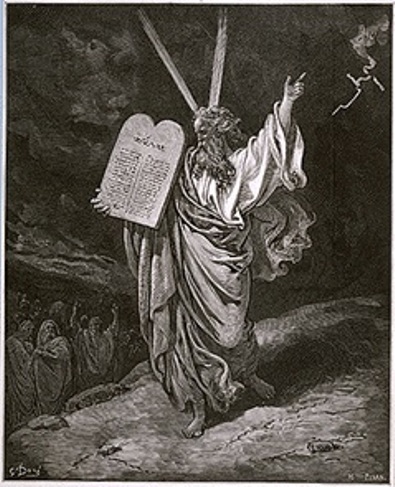
Figure Two: Gerry Healy Receives The Word --
Or Is It Bob Avakian?
Witness the inordinate and quasi-religious reverence shown toward the dialectical ramblings of Mao and Stalin. Few will need reminding of the cult of Kim-II-sung, Kim-Jong-iI (and now Kim Jong Un), or Enver Hoxha. Or, indeed, the thoroughly obsequious praise heaped on Gerry Healy -- Blessed Be His Name -- by prominent members of the now defunct WRP; or even the nauseating adulation lavished on Marlene Dixon of the DWP. Witness, too, the wholly un-merited hero worship of that towering mediocrity, Bob Avakian.
[I have posted dozens of examples of nauseating 'dialectical' sycophancy here, here, and here.]
In fact, Healy was well-known for fomenting strife among party members (with added violence, so we are told) in order to heighten the 'contradictions' in his micro-sect --, along 'sound' dialectical lines, of course. In the recent crisis in the UK-SWP, Alex Callinicos even spoke about of "lynch mobs". Of late we have also witnessed the divisive political and 'philosophical' gyrations of Chris Cutrone and the 'Platypus Affiliated Society'.
This phenomenon also helps account for much of the personal and organisation corruption revolutionary politics has witnessed over the last hundred years or more -- ranging from Mao's abuse of female comrades to the same with respect to Healy (on that, see Appendix A), down to the scandal that engulfed the UK-SWP a few years ago --, but there are many more examples of this malaise. All of these are partly the result of the noxious effect this doctrine has had on otherwise radical minds -- i.e., convincing them that they are somehow 'special' and hence, Raskolnikov-like, are above the 'conventional' morality of the 'herd', or, in some cases, even the laws of nature!
Megalomania coupled with an inflated view of one's own (surely cosmic) importance, a failure to face reality (courtesy of a theory that teaches that 'appearances' are 'contradicted' by underlying 'essence') descend like a cloud on the brains of such individuals --, and, of course, their acolytes. How else would it have been possible for them to rationalise so easily the pragmatic contradiction between, say, the widespread abuse of female comrades and a formal commitment to women's liberation, except by means of this contradictory theory: DM?
In this way, we have seen Dialectical Marxism replicate much of the abuse -- and most of sectarianism -- found in almost all known religions. [Again, on this, see Appendix A.] And no wonder: both were spawned by similar alienated patterns of ruling-class thought and social atomisation --, compounded, of course, by a cultic mentality, a pathological mind-set further aggravated by a divisive, Hermetic Creed capable of rationalising anything whatsoever and its opposite!
As Marx himself inadvertently admitted:
"It's possible that I shall make an ass of myself. But in that case one can always get out of it with a little dialectic. I have, of course, so worded my proposition as to be right either way." [Marx to Engels, 15/08/1857, MECW 40, p.152.]
Social Psychology Doesn't Apply To Dialecticians!
As far as the DM-'faithful' are concerned all this will fail to go even in one ear let alone straight out through the other. That is because they refuse to accept that any of the pressures bearing down on the rest of humanity could possibly have any effect on them, the DM-Elect.
Apparently, social psychology doesn't apply to these demi-gods!
Indeed, as far as The Chosen Few are concerned we can totally ignore these famous words:
"In the social production of their existence, men inevitably enter into definite relations, which are independent of their will, namely relations of production appropriate to a given stage in the development of their material forces of production. The totality of these relations of production constitutes the economic structure of society, the real foundation, on which arises a legal and political superstructure and to which correspond definite forms of social consciousness. The mode of production of material life conditions the general process of social, political and intellectual life. It is not the consciousness of men that determines their existence, but their social existence that determines their consciousness." [Marx (1968), p.181. Bold emphasis added.]
In response, it is often countered that tracing the fondness dialecticians have for Philosophy back to their class origin or current class position is just "crude reductionism!". In stark contrast, however, dialecticians are quite happy to reduce their opponents' theories and beliefs to their class origin or class position, while any attempt to do likewise with respect to their philosophical ideas is rejected out-of-hand -- with a...label.
Here, for example, is Lenin:
"In a word, Comrade Martov's formula will either remain a dead letter, an empty phrase, or it will be of benefit mainly and almost exclusively to 'intellectuals who are thoroughly imbued with bourgeois individualism' and do not wish to join an organisation. In words, Martov's formulation defends the interests of the broad strata of the proletariat, but in fact it serves the interests of the bourgeois intellectuals, who fight shy of proletarian discipline and organisation. No one will venture to deny that the intelligentsia, as a special stratum of modern capitalist society, is characterised, by and large, precisely by individualism and incapacity for discipline and organisation (cf., for example, Kautsky's well-known articles on the intelligentsia (partially reproduced below -- RL)). This, incidentally, is a feature which unfavourably distinguishes this social stratum from the proletariat; it is one of the reasons for the flabbiness and instability of the intellectual, which the proletariat so often feels; and this trait of the intelligentsia is intimately bound up with its customary mode of life, its mode of earning a livelihood, which in a great many respects approximates to the petty-bourgeois mode of existence (working in isolation or in very small groups, etc.). Nor is it fortuitous, lastly, that the defenders of Comrade Martov's formulation were the ones who had to cite the example of professors and high school students! It was not champions of a broad proletarian struggle who, in the controversy over Paragraph 1, took the field against champions of a radically conspiratorial organisation, as Comrades Martynov and Axelrod thought, but the supporters of bourgeois-intellectual individualism who clashed with the supporters of proletarian organisation and discipline." [Lenin (1976), pp.87-88. Bold emphasis and links added; italic emphases in the original.]
Quoting Kautsky on the social psychology of his opponents, Lenin further argued (in the previous paragraph having ascribed the words quoted below to the "wishy-washiness of the intellectual"):
"One can't help recalling in this connection the brilliant social and psychological characterisation of this latter quality recently given by Karl Kautsky. The Social Democratic parties of different countries suffer not infrequently nowadays from similar maladies, and it would be very, very useful for us to learn from more experienced comrades the correct diagnosis and the correct cure. Karl Kautsky's characterisation of certain intellectuals will therefore be only a seeming digression from our theme.
'The problem...that again interests us so keenly today is the antagonism between the intelligentsia and the proletariat. My colleagues (Kautsky is himself an intellectual, a writer and editor) will mostly be indignant that I admit this antagonism. But it actually exists, and, as in other cases, it would be the most inexpedient tactics to try to overcome the fact by denying it. This antagonism is a social one, it relates to classes, not to individuals. The individual intellectual, like the individual capitalist, may identify himself with the proletariat in its class struggle. When he does, he changes his character too. It is not this type of intellectual, who is still an exception among his class, that we shall mainly speak of in what follows. Unless otherwise stated, I shall use the word intellectual to mean only the common run of intellectual who takes the stand of bourgeois society, and who is characteristic of the intelligentsia as a class. This class stands in a certain antagonism to the proletariat.
'This antagonism differs, however, from the antagonism between labour and capital. The intellectual is not a capitalist. True, his standard of life is bourgeois, and he must maintain it if he is not to become a pauper; but at the same time he is compelled to sell the product of his labour, and often his labour-power, and is himself often enough exploited and humiliated by the capitalist. Hence the intellectual does not stand in any economic antagonism to the proletariat. But his status of life and his conditions of labour are not proletarian, and this gives rise to a certain antagonism in sentiments and ideas.
'...Quite different is the case of the intellectual. He does not fight by means of power, but by argument. His weapons are his personal knowledge, his personal ability, his personal convictions. He can attain to any position at all only through his personal qualities. Hence the freest play for his individuality seems to him the prime condition for successful activity. It is only with difficulty that he submits to being a part subordinate to a whole, and then only from necessity, not from inclination. He recognises the need of discipline only for the mass, not for the elect minds. And of course he counts himself among the latter....
'...The typical intellectual à la Stockmann regards a "compact majority" as a monster that must be overthrown....'
"Just such feeble whining of intellectuals who happened to find themselves in the minority, and nothing more, was the refusal of Martov and his friends to be named for office merely because the old circle had not been endorsed, as were their complaints of a state of siege and emergency laws 'against particular groups', which Martov cared nothing about when Yuzhny Rabochy and Rabocheye Dyelo were dissolved, but only came to care about when his group was dissolved.
"Just such feeble whining of intellectuals who happened to find themselves in the minority was that endless torrent of complaints, reproaches, hints, accusations, slanders, and insinuations regarding the 'compact majority' which was started by Martov and which poured out in such a flood at our Party Congress (and even more so after).
"The minority bitterly complained of the 'false accusation of opportunism'. Well, it had to do something to conceal the unpleasant fact that it was opportunists, who in most cases had followed the anti-Iskra-ists -- and partly these anti-Iskra-ists themselves -- that made up the compact minority, seizing with both hands on the championship of the circle spirit in Party institutions, opportunism in arguments, philistinism in Party affairs, and the instability and wishy-washiness of the intellectual." [Ibid., pp.160-64. Bold emphases and links added; italic emphases in the original. Quotation marks altered to conform with the conventions adopted at this site.]
Trotsky was also happy to do likewise (this time applying the following analysis to those in his own party who opposed him, but failing to do so with respect to those who supported him, or, indeed, to himself):
"[Y]ou [James Burnham -- RL], likewise, seek an ideal party democracy which would secure forever and for everybody the possibility of saying and doing whatever popped into his head, and which would insure the party against bureaucratic degeneration. You overlook a trifle, namely, that the party is not an arena for the assertion of free individuality, but an instrument of the proletarian revolution; that only a victorious revolution is capable of preventing the degeneration not only of the party but of the proletariat itself and of modern civilization as a whole. You do not see that our American section is not sick from too much centralism -- it is laughable even to talk about it -- but from a monstrous abuse and distortion of democracy on the part of petty-bourgeois elements. This is at the root of the present crisis....
"Petty-bourgeois, and especially declassed elements, divorced from the proletariat, vegetate in an artificial and shut-in environment. They have ample time to dabble in politics or its substitute. They pick out faults, exchange all sorts of tidbits and gossip concerning happenings among the party 'tops.' They always locate a leader who initiates them into all the 'secrets.' Discussion is their native element. No amount of democracy is ever enough for them. For their war of words they seek the fourth dimension. They become jittery, they revolve in a vicious circle, and they quench their thirst with salt water. Do you want to know the organizational program of the opposition? It consists of a mad hunt for the fourth dimension of party democracy. In practice this means burying politics beneath discussion; and burying centralism beneath the anarchy of the intellectual circles. When a few thousand workers join the party, they will call the petty-bourgeois anarchists severely to order. The sooner, the better." [Trotsky (1971), pp.116-17. Bold emphases and link added. Quotation marks altered to conform with the conventions adopted at this site. Needless to say, the "few thousand" workers failed to show up. For Burnham's reply to Trotsky, see here.]
"If we exclude that stratum of the intelligentsia which directly serves the working masses, as workers' doctors, lawyers, and so on (a stratum which, as a general rule, is composed of the less talented representatives of these professions), then we see that the most important and influential part of the intelligentsia owes its livelihood to payments out of industrial profit, rent from land or the state budget, and thus is directly or indirectly dependent on the capitalist classes or the capitalist state.
"Abstractly considered, this material dependence puts out of the question only militant political activity in the anti-capitalist ranks, but not spiritual freedom in relation to the class which provides employment. In actual fact, however, this is not so. Precisely the 'spiritual' nature of the work that the intelligentsia do inevitably forms a spiritual tie between them and the possessing classes." [Trotsky, The Intelligentsia And Socialism. Bold emphases added.]
Indeed, this is how Trotsky analysed the clique around Stalin:
"The entire effort of Stalin, with whom at that time Zinoviev and Kamenev were working hand in hand, was thenceforth directed to freeing the party machine from the control of the rank-and-file members of the party. In this struggle for 'stability' of the Central Committee, Stalin proved the most consistent and reliable among his colleagues. He had no need to tear himself away from international problems; he had never been concerned with them. The petty bourgeois outlook of the new ruling stratum was his own outlook. He profoundly believed that the task of creating socialism was national and administrative in its nature. He looked upon the Communist International as a necessary evil would should be used so far as possible for the purposes of foreign policy. His own party kept a value in his eyes merely as a submissive support for the machine." [Trotsky (1977), p.97. Bold emphasis and links added. Quotation marks altered to conform with the conventions adopted at this site. See, also George Novack's comments on this topic.]
So, Lenin and Trotsky saw nothing wrong with applying each of their analyses to the behaviour of, and the ideas formed by, fellow Marxists. But, which Leninist, or which Trotskyist today, is going to accuse either of these two of "crude reductionism"?
In which case, while it seems quite legitimate for dialecticians to 'reduce' their enemies and opponents' -- and, indeed, their fellow Marxists' -- ideas, attitudes and behaviour to their class position, or class origin, it is illegitimate for anyone to do the same to them!
On the other hand, Marxists are quite right to point out that when, for example, union militants are drafted into the trade union machine, becoming bureaucrats themselves, their new material conditions have a predictable, perhaps even inevitable, effect on the attitudes they adopt and the ideas they are capable of forming. However, the very same Marxists will resist with no little vehemence the same conclusion when it is applied to them, their material circumstances or their class position.
If the class analysis promoted at this site is rejected for some reason, the only other conclusion possible is that it must be a sheer coincidence that revolutionary parties the world over have replicated, time and again, practically every single fault and foible that afflicts the genuine god-botherers among us -- even down to their reliance on an obscure book about an invisible 'Being' -- in this case, Hegel's Logic.
So, while all these faults and foibles have well-known material and social causes when they descend upon the duplicitous, the alienated, the superstitious, and the gullible, they apparently have no cause whatsoever when they similarly grace the sanctified lives of our very own Immaculate Dialectical Saints. In which case, faults and foibles like these can safely be ignored, never spoken about in polite company.
Until, that is, they are caught with their dialectical pants down -- and even then these "scurrilous accusations" can be brushed aside as "bourgeois propaganda", or part of a heinous "witch-hunt".
This means that the Dialectical Merry-go-round takes another spin across the flatlands of failure, its participants ever more convinced of their semi-divine infallibility and ideological purity.
Of course, the above might seem to suggest (to some) that this analysis resembles those that critics of Marxism have always advanced. However, the difference here is that this attack is being launched only against DM, not HM, and by a fellow revolutionary. It is also backed-up by an analysis that is fully compatible with HM, even if it is completely destructive of traditional forms-of-thought.
And, it is being advanced with the sole aim of making our movement more, not less, successful.
In order to demonstrate that the above comments aren't merely academic I have added to Essay Nine Part Two three detailed Case Studies -- including the alleged role that DM played in the events of 1917 -- that help confirm the indictments presented in this Essay. They have been omitted from this Summary solely for reasons of space.
According to HM, humanity will only rid itself of class division and oppression through the collective action of ordinary workers, not because of the operation of the metaphysical laws found in DM put into 'practice' by a revolutionary 'elite'.
In their own small way, therefore, these Essays are aimed at helping bring an end to the baleful influence that this regressive, anti-materialist theory (DM) has had on revolutionary socialism so that HM can at last begin to stand for a fully Humanised Marxism.
Given all that has gone before, unless we are clear that DM has played a significant role preventing Marxism from being "seized by the masses" -- and hence in exacerbating and prolonging the chronic sickness of Dialectical Marxism itself -- unless we are clear about that, all we can ever expect from our efforts are countless more dead workers.
Followed, of course, by a Dead Movement; DM, the final negation of this Hermetic Dead-End.
Word Count: 16,690
Latest Update: 27/01/21
© Rosa Lichtenstein 2024
Hits Since 31/03/08: