16-11-01 -- Summary Of Essay Eleven Part One: The Mysterious "Totality" -- WTF Is It?
If you are using Internet Explorer 10 (or later), you might find some of the links I have used won't work properly unless you switch to 'Compatibility View' (in the Tools Menu); for IE11 select 'Compatibility View Settings' and then add this site (anti-dialectics.co.uk). Microsoft's new browser, Edge, automatically renders these links compatible; Windows 10 also automatically makes IE11 compatible with this site.
However, if you are using Windows 10, Microsoft's browsers, IE11 and Edge, unfortunately appear to colour these links somewhat erratically. They are meant to be dark blue, but those two browsers render them intermittently mid-blue, light blue, yellow, purple and red!
Firefox and Chrome reproduce them correctly.
~~~~~~oOo~~~~~~
This is an Introductory Essay, which has been written for those who find the main Essays either too long, or too difficult. It doesn't pretend to be comprehensive since it is simply a summary of the core ideas presented at this site. Most of the supporting evidence and argument found in each of the main Essays has been omitted. Anyone wanting more details, or who would like to examine my arguments in full, should consult the Essay for which this is a summary. [In this particular case, that can be found here.]
As is the case with all my work, nothing here should be read as an attack either on Historical Materialism [HM] -- a theory I fully accept --, or, indeed, on revolutionary socialism. I remain as committed to the self-emancipation of the working class and the dictatorship of the proletariat as I was when I first became a revolutionary nearly thirty years ago.
The difference between Dialectical Materialism [DM] and HM, as I see it, is explained here.
Phrases like "ruling-class theory", "ruling-class view of reality", "ruling-class ideology" (etc.) used at this site (in connection with Traditional Philosophy and DM), aren't meant to suggest that all or even most members of various ruling-classes actually invented these ways of thinking or of seeing the world (although some of them did -- for example, Heraclitus, Plato, Cicero, and Marcus Aurelius). They are intended to highlight theories (or "ruling ideas") that are conducive to, or which rationalise the interests of the various ruling-classes history has inflicted on humanity, whoever invents them. Up until recently this dogmatic approach to knowledge had almost invariably been promoted by thinkers who either relied on ruling-class patronage, or who, in one capacity or another, helped run the system for the elite.**
However, that will become the central topic of Parts Two and Three of Essay Twelve (when they are published); until then, the reader is directed here, here, and here for more details.
[**Exactly how this applies to DM will, of course, be explained in the other Essays published at this site (especially here, here, and here). In addition to the three links in the previous paragraph, I have summarised the argument (but this time aimed at absolute beginners!) here.]
[Latest Update: 25/01/20.]
Anyone using these links must remember that they will be skipping past supporting argument and evidence set out in earlier sections.
If your Firewall/Browser has a pop-up blocker, you will need to press the "Ctrl" key at the same time or these and the other links here won't work!
I have adjusted the font size used at this site to ensure that even those with impaired vision can read what I have to say. However, if the text is either too big or too small for you, please adjust your browser settings!
1) So What Exactly Is the 'Totality'?
b) 'God', The "Totality" And Negative Theology
c) The "It's Everything" Gambit
d) Well, What Do The Dialectical Classics Have To Say?
2) Where The Shoe Originally Pinched
d) Dialecticians In Wonderland
f) Interconnected -- Or Hermetically Sealed -- Units?
Summary Of My Main Objections To Dialectical Materialism
Abbreviations Used At This Site
Essay Eleven Part One is largely concerned with the DM-Totality -- as that term is applied to the natural world.
The application of holist ideas to human history and social development won't be called into question here -- or anywhere else for that matter -- by the present author.
Imagine for a moment, if you will, Hamlet without its main character, the Prince, or at least without a single description of 'him' -- such as, whether 'he' is indeed a Prince, is male or female, or even if 'he' is a human being. Questions would rightly be asked about what role this 'character' could possibly have in a play supposedly about 'him', just as doubts would be raised about the competence or even the sanity of its author, William Shakespeare.
Fortunately, we needn't indulge in such flights-of-fancy.
Imagine now, if you can, a theory which its supporters tell us is among other things: (1) The "world-view" of the proletariat; (2) A completely general theory of everything in existence, how it develops and changes, (or which is a 'method' aimed to that end); (3) An explanation how everything is interconnected with everything else in something called "The Totality"; and that (4) "The Totality" is itself a centrally-important concept, to such an extent that nothing can be fully understood without reference to, or in connection with, it.
Consider, too, the following rather odd fact: every single one of its theorists studiously refuses to say what this "Totality" actually is, or what its supposed "interconnections" are --, or even how they know so much (or, rather, so little) about this terminally obscure 'object'/process.
Ponder no more! For that theory is DM, those theorists are Dialectical Marxists, and they are world champion prevaricators.
[DM = Dialectical Materialism/Materialist depending on the context.]
If you still harbour doubts, I invite you, dear reader, to search through their writings (and, for my sins, I have had to do just that!). Even if you are the slightest bit interested, you will find precious little to help you decide what DM is in fact about, for its most avid supporters have yet to tell anyone (least of all one another) what this mysterious "Totality" actually is!
So, this isn't so much Hamlet without the Prince, it is Hamlet without the..., er..., well..., er..., what?
Indeed, over the last thirty years or so I have made a point of asking the many DM-fans I know or have met (personally, or on the Internet) what they think the "Totality" actually is. Of those who could be bothered to reply, most were either puzzled (or slightly annoyed) that I even thought to ask such an impertinent question. Some responded with "Nature, what else?", but refused to say any more (perhaps because, as we will soon discover, there is no more to be said). Others gestured airily toward the heavens, saying "All that!" -- rather like those parents who try to explain to small children where 'God' is with an "He's up there, in heaven", wafting their hands vaguely skywards. Still others confessed they didn't know, but declared that they still believed in it, just like those children with hand-waving parents.
Others of a more scientific frame-of-mind referred me to the "Big Bang", forgetting that this is a theory of origins; it tells us nothing about "everything", as we will also soon find out.
At this point, readers of a more kindly or tolerant disposition might be tempted to respond: "This can't be so! Surely someone has specified clearly what the DM-"Totality" actually is. After all, dialecticians have had at least 150 years to come up with something!"
To be sure, a handful of DM-theorists have outlined a few vague ideas about this mysterious 'entity' --, but beyond the bare bones they have either sat on their hands or nervously looked the other way.
I suspect these guys could prevaricate for their country.
Indeed, dialecticians are remarkably coy about their "Totality", and it isn't difficult to see why: There isn't one.
Or, rather: there is in fact no way of referring to whatever it is they think they want to refer to as the "Totality"!
This entity was born out of mysticism, and there it remains entombed to this day.
No wonder no one can tell us what it is!
"God", The "Totality", And The Via Negativa
Just as it is impossible to say who or what 'God' is, it is no less difficult to say what the "Totality" is, either. That isn't so much because of what these two words might appear to mean, but because both are in fact devoid of meaning -- and this is so for remarkably similar reasons.
For believers, 'God' is unlike anything you or I or anyone else could possibly imagine, conceive, or sensibly put into words. Those tempted to think otherwise have simply latched onto an inferior sort of 'being' in whose 'name' it wouldn't be worth persecuting a single infidel.
Naturally, this means that the faithful have found it impossible to speak about 'God' without using inappropriate metaphors and misleading analogies; theologians have for many centuries used linguistic tricks and dodges like this in their vain endeavour to make 'God'-talk vaguely comprehensible. Unfortunately, even though some of the mediating terms they have employed are well enough understood (such as "father", or "son"), the intentional target of all this analogising isn't. What precisely is being analogised?
The response? Yet more gobbledygook or deafening silence...
In fact, it is impossible to answer that question without demoting 'God' so that 'He' is now on a level with 'His' alleged creation, for if you have to compare 'God' to one of 'His' creatures in order to understand 'His' nature, 'He' can no longer be distinguished from them (except, perhaps, in terms of 'His' magnitude, which would mean 'He' resembled, say, a huge star when compared to a smaller one). On the other hand, if 'He' is to be distinguished from 'His' supposed creation, then any words used to describe 'His' inferior creation cannot be used to characterise 'Him' without implicating 'Him' in just such an ignominious ontological demotion.
The gap between the 'Divine' and the mundane is infinite, so we are told, and any attempt to bridge it would be tantamount to blasphemy, for it will either identify 'The Creation' with the 'Divine' or reduce the 'Divine' to the mundane.
Both approaches having failed, believers often fall back on the time-honoured via negativa, beloved of Christian Mystics. For them, 'God' is not this, not that, not...
As that lapsed, right-wing atheist, the late Anthony Flew, once observed: in this way 'God' suffers "death by a thousand qualifications". In the end, it becomes impossible to distinguish 'God' from nothing.
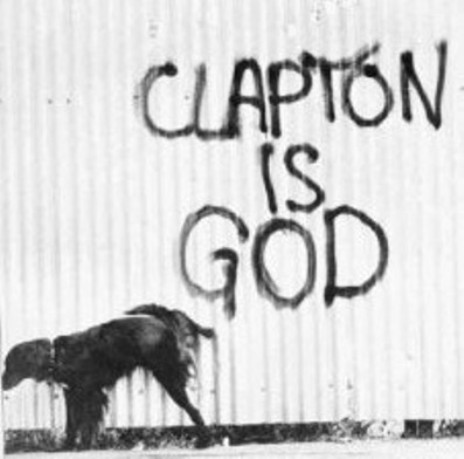
But, if we know nothing whatsoever about 'God' (except we demote 'Him' in the above manner), if 'He' is indeed indistinguishable from 'nothing', how is the use of "God" any different from employing, say, "Slithy Tove"? Other than an appeal to a rather questionable tradition --, wherein the word "God" has been attached to all manner of things (ranging from money to natural powers and forces, from assorted Roman Emperors to..., yes..., even Eric Clapton) --, what can the faithful point to in order to explain this word to those who simply see before them on the page three perfectly ordinary letters ("G", "o", and "d") knitted together into an inky sort of Trinity --, "God"?
Figure One: Is Clapton 'God'?
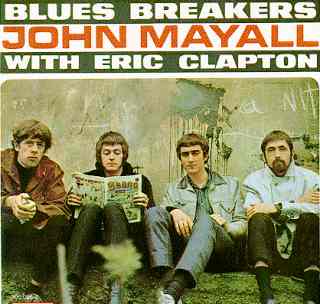
Figure Two: This Album Says "Maybe!"
At this point, some readers might be tempted to respond with the "It's everything" ploy -- for example: "Damn it! It's perfectly clear what that the Totality is: it's everything!"). Unfortunately, that reply is little help since it would simply prompt the next question: "And what does that include?"
As we are about to discover as this Essay unfolds, there is no way to answer that particular query that won't sink DM one millimetre per second slower than it has already sunk Theology.
At this point, it is worth noting that we are beginning to encounter the same sort of problems in connection with the "Totality" that confront Believers-in-The-Almighty, who also employ obscure metaphors and vague analogies to try to describe the nature of 'God'. Keep that thought in mind as this Summary unfolds.
So, down this road, one suspects, lies our very own dialectical via negativa, as DM-theorists tell us time and again, "No, the "Totality" does not include this, or that, or this, or...".
On the other hand, even if DM-theorists managed to define their "Totality" carefully, or even fully, it would plainly be a creature of convention --, and, like "God", a human invention.
No wonder DM-fans fall silent when asked to fill in the details about their 'God'..., er, sorry, their "Totality".
As we will soon find out, this 'inverted' DM-Deity -- the "Totality" -- will also die the death of a thousand qualifications.
Or, to be more honest, the death of a thousand prevarications...
[I return to consider the "It's everything!" ploy in much more detail, here.]
Well, What Do The Dialectical Classics Have To Say?
The short answer is "Not a lot".
The long answer is "Well.., er.., not a lot, squared."
[A representative selection of the vague sorts of things DM-theorists have said about the "Totality" can be inspected here and here.]
A few years ago, Martin Jay published an excellent book entitled Marxism And Totality. The Adventures Of A Concept From Lukács To Habermas [i.e., Jay (1984)]but, in over 500 pages he studiously omitted to tell us what his book was actually about!
To be sure, in Chapter One, Jay very helpfully summarised classic and early modern Holist theories of nature and society, but those theories are themselves no less vague. Perhaps because he found little material in the DM-classics (or, indeed, in the writings of 'systematic' and other academic dialecticians) to help him explain this vague concept, Jay ducked the question whether Ancient Greek and Early Modern theories of nature -- or, of 'the Whole' -- were the same as, or were different from, one another --, or, indeed, were the same as, or were different from, the DM-"Totality".
After all: how would anyone be able to decide?
For instance, how would it be possible to ascertain whether or not Hegel's 'Whole' is the same as, or is different from, say, Plato's? Or, Plotinus's? Or, Aristotle's? Or, any of the many and varied "Wholes" that litter most of the world's mystical belief systems?
Admittedly, those aforementioned mystics all use, or have used, typographically similar-looking words (such as, "Being", "The Whole", "The Totality", etc.), but, if the use of similar-looking words were enough to equate whatever they supposedly depicted, we would surely be able to conclude that, for example, Plato's "Forms" were identical to those complicated, pre-printed sheets of paper you have to complete in order to apply for a job, obtain a driving licence or secure a credit card. Plainly, the use of typographically similar-looking words isn't sufficient to identify the many 'Wholes' that Traditional Thinkers have concocted over the last two-and-a-half millennia.
After all, does anyone have access to an Identikit picture of the "Totality" that enables them to pick this mysterious object out of a Cosmic line-up of likely candidates? Has anyone seen its likeness etched in the sand, shaped in the clouds, or formed on the surface of Mars -- in the way that some claim to have spotted images of Jesus or The Virgin Mary in a slice of toast or on a grape?
Indeed, precisely what is the criterion of identity for mystical and/or 'dialectical' "Totalities"?
Worse still: we don't even possess so much as a partial description of a single "Totality", ancient or modern, to assist us in this rather futile quest. Can you imagine trying to decide whether or not two individuals -- say, Woodruff Durfendorfer and Arthur Farfenickle -- were the same or were different if you were given no clear description to work with, no picture to guide you, and no DNA to rely on? But even then you would at least have something to work with: the knowledge that they are supposed to be human beings. And yet, in relation to the various "Wholes" and "Totalities" that assorted mystics have invented we don't even have this much to go on -- we have no idea what kind of 'entity' we are dealing with, the existence and identity of which we are being asked to contemplate. We have nothing at all to assist us. No good doing a Google search or consulting Wikipedia.
Of course, as noted above, this puzzle isn't helped by the fact that not a single one of those ancient 'thinkers' was all that specific about the nature and extent of his/her particular "Whole" -- neither were the ancient (or modern) mystics, and for obvious reasons. After all, a crystal clear mystic would lose his or her licence to confuse.
But, in relation to the entire confusion of obscure "Wholists", ancient and modern -- "confusion" is the collective noun I have just invented for such Mystics and Wholists --, the Dialectical Mystics are easily the vaguest, most equivocal and evasive. Prevarication and obfuscation taken way beyond the call of duty.
The rest of Jay's book is devoted to expounding what various prolix and studiously incomprehensible dialecticians have or haven't thought about history, society and the economy -- as possible examples of what can only be called, 'sub-totalities'. However, as far as can be ascertained, and except for the opening chapter, the "Totality" itself is conspicuous by its absence, which is, of course, quite remarkable in itself. Indeed, it is decidedly odd, just as odd as it would have been had Darwin forgotten to mention natural selection, or had omitted all talk of species, past, present or future, from On The Origin Of Species.
This isn't to pick on Jay, since his book is an excellent guide in its own way -- a sort of Dialectician's Alice, as it were. To be sure, if anyone wants to know what Dialectical Marxists think about social wholes (albeit, expressed in what looks for all the world like an obscure Venusian dialect), this is the book to consult.
In which case, Dialectical Marxism is still missing its Prince of Denmark.
Several in the audience are getting restless.
They want their money back.
Where The Shoe Originally Pinched
This project began back in 1998 as an extended review of John Rees's book The Algebra Of Revolution [Rees (1998a), or TAR], which, for all its faults, has proven to be widely influential in one of the most geographically-extensive Trotskyist Tendencies on the planet (the IST/UK-SWP). [However, since this was first written, Rees has resigned from the UK-SWP and now helps run Counterfire, which means that his ideas are no longer viewed by the IST as ideologically sound; comrades who at one time lauded this book now either do the opposite, or they simply ignore it! An ironic fate for any book on dialectics to have to endure.] In that case, his book is well placed to do real damage.
Anyway, since Rees is one of the most recent DM-authors to put the "Totality" right at the centre of his ideas, it still seems a reasonably good place to start.
Unfortunately, as we will soon see, it doesn't matter where we start, the superficial 'descriptions' of this mysterious entity (advanced by DM-fans, drawn from all wings of Dialectical Marxism) turn out to be thinner than an anorexic flatworm!

Figure Three: Flatworm -- Rather Substantial In Comparison?
In view of the foregoing, it is no surprise therefore to find that even though Rees clearly believes the "Totality" is a centrally-important DM-concept [Rees (1998a), pp.5-8], or 'entity', apart from a few rather vague gestures at defining this term, or describing this 'object', he never really tells us what the "Totality" is!
One of his few attempts to explain this notion is the following:
"Totality refers to the insistence that the various seemingly separate elements of which the world is composed are in fact related to each other." [Rees (1998a), p.5.]
There seems to be something wrong with this passage since it tells us that the "Totality" is in fact an "insistence".
Can this be what "everything" is, an "insistence"?
Is this what the Big Bang ushered forth? An ever-expanding "insistence"?
Worse still: if the "Totality" were in fact an "insistence", it would have been foisted on nature, something DM-theorists like Rees tell us they never do.
[The various ways that mystics -- both the religious variety (many of whom also appealed to 'contradictions' and UOs to account for change) and the DM-cohort -- have tried to define their "Totality" can be found here and here.]
In the absence of anything even remotely resembling a superficial characterisation (let alone a definition) of this obscure DM-'object', the "Totality", we are forced to press the question DM-theorists consistently avoid or deflect: What exactly is the DM-"Totality"?
When pressed, dialecticians sometimes appeal to "nature" (or perhaps "the Universe") as a physical embodiment of the "Totality", but this is of little help. As we will soon see, vague gestures like this initiate an 'open season', permitting entry to rather too many objects and processes one would prefer to keep out.
However, one thing DM-theorists all seem to agree on is that this "Totality" is an integrated whole in which everything is interconnected. [On that, see here.]
Nevertheless, the DM-classics fail to tell curious readers whether or not the "Totality" includes the past. The past is surely part of nature, and the universe, one would suppose. And yet, the past doesn't actually exist (except, perhaps, for those with a novel understanding of the word "exist"). But, if that is so, and if the past is included as part of the "Totality", the "Totality" must surely contain, or include, many things that don't actually exist. That might make it difficult to explain how everything in the "Totality" is interconnected. Clearly, no matter how large and inclusive the Universe is now supposed to be, most things that have existed at some point did so in the past. In that case, objects and processes in the present must be interconnected with far more non-existent things than existents. The word "interconnected" would then become rather difficult to account for in anything other than Idealist terms.
If it is now responded that the past is interconnected with the present because of certain processes that stretch from the past into the present, then that would mean that while the present is indeed connected with the past, the past is not actually interconnected with it -- unless, of course, we are prepared to envisage 'backwards' causation, with the present is back-connected, as it were, with the non-existent past. Hence, at best, this would mean that the vast bulk of the "Totality", while connected, can't actually be interconnected, as we had been led to believe.
On the other hand, if the past is said to exist (as part of some sort of Einsteinian four-dimensional manifold) then that would scupper the dialectical belief in change. That is because there is no objective change in such a world. On such a view, change is merely the result of our subjective perception of how successive orthogonal hyperplane slices through this manifold seem to us to be related to one another.
And even if that particular option is rejected for some reason, the vast bulk of the "Totality" would still be changeless. Even if the past does exist somehow, it itself couldn't change (into what?). That would mean that the vast bulk of the "Totality" would be just as frozen as Plato's Forms.
Alternatively, if the existence of the past is rejected, then dialecticians might find it difficult to account for the present. How can anything non-existent create all that now exists?
Of course, the same sort of problems afflict the "Totality" in relation both to the present and to the future. Given that 'the present' lasts only a moment (possibly less than a yocto second, i.e., 10-24 seconds), it is surely far too ephemeral to be interconnected with anything -- if the "Totality" consists of only the present state of the Universe. It is hard to see how such a ghostly entity as this could account for anything. Moreover, if the present is indeed interconnected with something, what is it? As we saw, it can't be the past, which doesn't exist. It can't be the future, either, and for the same reason.
It rather looks like the DM-"Totality" is indeed less substantial than the anorexic flatworm mentioned earlier.
[Possible responses to these and other 'problems' are considered in detail in Essay Eleven, Part One.]
Furthermore, the word "everything" is a little too vague a word to be of much use since it would allow the "Totality" to contain some decidedly odd items. [On that, see below.]
It could be argued that we should include in the "Totality" all and only those objects and processes that scientists acknowledge -- either now or in the future --, supported by the weight of evidence. But that might not be such a good idea. If we naively rely on what scientists have at some point or other told us exists then the "Totality" would contain things like Caloric, Phlogiston, Piltdown Man and the Crystalline Spheres (as well as other peculiar objects and processes that scientists used to believe were 'objective').
But, what should we conclude if and when scientists revise their ideas, or change their minds, as they continually do? Would this mean that (1) The "Totality" itself changes whenever the scientific community ceases to acknowledge, or it even rejects, the existence of what had once been considered to be 'objective' objects and processes? Or, would this: (2) Show that scientists' beliefs about 'objectivity' itself had changed? If one or both of these were the case, would this not in turn suggest: (3) That some (perhaps all?) 'objective' ideas are really only 'subjective'? Wouldn't this cast a shadow over the 'objectivity' of science itself?
But, if scientists are now denied exclusive rights in this area, and DM-theorists arrogate to themselves the right to decide, then one can only sympathise with the unfortunate comrade who has to chair the 'dialectical selection panel' charged with deciding whether or not any of the following belong to the "Totality":
Vacua, mirages, illusions, holes, surfaces, corners, shadows, the 'Unconscious', mirror and lens images, para-reflections, the perspectival properties of bodies, phantom limbs, dreams, rainbows, refractions, pains, hallucinations, memories, the mysterious powers of the echeneis fish, emotions, the Ether, N Rays, The Odic Force, Orgone, the Fifth Force, Bioenergy, Polywater, Superstrings, branched time zones, Axions, Branes, the Higgs Boson, virtual particles, particles themselves, selfish genes, I.Q., race, Morphogenic Fields, homeopathic phenomena, 'Mitochondrial Eve', the Placebo effect, gravitons, tachyons, Gaia, singularities, geodesics, gravitational waves, electrons travelling 'backward' in time, magnetic monopoles, tetraneutrons, phase space, photinos, dark matter, the Field, world-lines, Strange Attractors, Cold Fusion, MACHOs, WIMPs, spinors, the future, the past and the specious present. [Details concerning what many of the above are can be found in Essay Eleven Part One, here.]
[It is worth pointing out that this speculation has been forced on us since DM-fans refuse to tell us what their "Totality" actually is and actually contains.]
However, without such a panel, the DM-"Totality" would be as Ideal as Hegel's Absolute ever was -- or, of course, it would largely be empty.
Moreover, if Lenin is right and all knowledge is provisional -- and it is worth recalling here that Lenin himself described the existence of the Ether as "objective" [Lenin (1972), pp.50, 312, 314, 329] --, then the "Totality" would have to change whenever its contents list was revised (as indeed it might have to do soon, given the fact that the Higgs Boson is barely clinging onto its theoretical life right now, as it seems is 'Dark Matter', too). [Of course, since this was written, scientists claim to have found this elusive particle. One can only hope it doesn't go the way of Caloric and Phlogiston.] Once more, that would mean that this supposedly 'objective' "Totality" must change in line with the decisions we make, which would identify it even more closely with Hegel's Absolute.
This isn't a very promising start, but, alas for DM-fans, it gets worse.
If we can't decide on what basis to include or exclude things from this avowedly contradictory "Totality", then perhaps it includes things that not only do not exist, but things that cannot exist?
This latest possibility now poses far more serious problems for any attempt to construct an Ontological Definition of the "Totality", like that offered above. That is because several DM-theses imply the 'perimeter fence' (as it were) encircling the "Totality" is full of holes.
In fact, the DM-"Totality" more closely resembles a colander than it does a wok.
While rival ontological systems often operate with some sort of closed-border policy -- admitting the existence of certain things, disallowing others -- it turns out that DM-theorists can't reject anything at all, since they openly admit (if not adamantly insist upon) the existence of countless contradictions (as well as paradoxes) -- and endless trillions of them -- indeed, possibly hundreds, if not thousands in each and every atom in the entire universe!
Hence, the 'DM-boundary-fence' isn't so much porous as non-existent. It is about as effective as the "perimeters" the cops regularly set up in 24, the TV film series; the miscreants always manage to get through. The "Totality", it seems, could contain anything, including impossible objects -- not just contradictory objects and processes, but mythical and imaginary ones, too. Maybe it includes four-edged hexagons, the round square, the golden mountain, unicorns, the Olympian Gods, the end of the rainbow, and perhaps even the Adhedral Triangle?
Anyone tempted to respond that the above list is absurd since it contains contradictory items, which can be ruled out in advance, should once again consult their local DM-Soothsayer before they jump to that conclusion. In fact, given well-known DM-principles, it isn't easy to see how any of the above (and many more besides) may be rejected on such a peremptory, a priori basis.
Thus, if the DM-"Totality" is to be rescued from oblivion, some way must be found to stop these and countless other absurdities before they cross its recklessly permeable boundary.
It could be objected once again that this is just ridiculous; dialecticians only acknowledge the existence of contradictions that can be empirically verified. Hence, they don't countenance the actuality of 'theoretical' contradictions and assorted absurdities, nor do they admit the mere existence of all 'contradictory', imaginary, or impossible objects.
But, this counter-claim is demonstrably incorrect. [That allegation is substantiated in detail in Essays Seven and Eleven Part One.] Anyway, even if it were the case that DM-theorists don't admit, or even reject, the existence of such entities, there is in fact nothing in their 'logic' that rules them out.
Again, it could be argued that 'contradictory objects' are easily excluded because they aren't material, and do not represent verifiable material forces.
But who says? How do we know that scientists might not one day discover weird and wonderful things like these? They already have a few of their own to contend with; several of them were listed above. Electrons travelling backwards in time and events happening before they occur seem pretty absurd. Would anyone like to tell scientists that electrons travelling 'backwards' in time are impossible, or that 'quantum objects' can't be in two places at once?
[UO = Unity of Opposites; DL = Dialectical Logic; FL = Formal Logic.]
Even worse still, as noted earlier: objects and processes like these can't be ruled out by anyone appealing to the terminally obscure notions DL supplies its unfortunate adepts. Because of that, DM-theorists openly admit the existence of countless billion contradictions and other assorted 'impossibilities', right throughout the entire universe -- the existence of which can't be verified by empirical means, either. [On that, see below.]
In fact, if everything in existence were a UO (as the DM-classics tell us) then there should be at least as many contradictions in reality as there are sub-atomic particles (and possibly even more). Hence, the aforementioned 'impossibilities' can't be ruled out in advance of all the evidence having been considered, certainly not as a result of 'principles' exclusive to DL.
Indeed, DM-theorists already acknowledge the actual existence of contradictory objects, processes and assorted 'impossibilities' prior to all (or even most) of the evidence having been collected (and, in many cases, in abeyance of any evidence at all!), since those who agree with Lenin and Hegel insist that every object and process is, or 'contains', a UO.
[The reason for the 'scare' quotes around "contains" is explained in Essay Eight Part One.]
If so, for all that even dialecticians know, the "Totality" could contain countless as-yet-undiscovered absurdities. And this is all the more so since DM-theorists themselves already confuse contradictions with absurdities, alongside a host of other oddities, too.
Furthermore, if Engels and Lenin are to be believed, an infinite amount of knowledge still awaits discovery. Hence, at any point in history (such as the present), humanity must be infinitely ignorant of the final contents of -- and the principles governing -- the universe, or the "Totality" (that is, if there is such a 'thing' as the "Totality"). That being the case, those who rely on DL are in no position to rule such absurdities out with anything other than almost infinite uncertainty. The only way such oddities could be excluded would be on the back of an a priori appeal to principles exclusive to FL -- or, indeed, exclusive to ordinary language --, and thus on the basis of rules that are incompatible with those found in DL. [On that, see Essay Four.]
As we have already seen (in connection with Engels's analysis of motion and several other core DM-theses, here, here, here, here, here and here), DM-theorists already acknowledge the existence of contradictory objects and events. Examples include the unity of opposite poles in a magnet, 'contradictory' opposing forces throughout nature (at both the macro-, and the micro-level), contradictory moving objects, contradictory numbers and mathematical concepts, seeds which negate themselves, the existence of actual infinities (that is, the existence of something which both terminates (so that it is a determinate existent) and which does not terminate), the fundamentally contradictory nature of matter (in that it is both wave and particle, continuous and discontinuous, all at once), and contradictory cells (that are somehow alive and dead at the same time -- or they are teetering on the edge of, or they are caught between, life and death), and so on.
This means that DM-theorists cannot consistently exclude any of the contradictory and unlikely entities listed earlier solely on the basis of their assumed 'contradictory' nature(s). Theorists who postulate the existence of contradictions everywhere, but who suddenly become arbitrarily fastidious just when it suits them, shouldn't expect to be taken seriously.
But, what could be more contradictory than a "Totality" that admits among its denizens things that not only do not exist (like the past), but also those that can't exist (such as DM-abstractions, since if they exist, they must be concrete)?
Unfortunately, once this metaphysical roller-coaster start to move it takes something a little more substantial than DL to stop it.
If DM isn't to be imposed on the world, but read from it -- as its supporters constantly intone -- then, as it now turns out, DM-theorists cannot consistently stipulate what their "Totality" does or doesn't contain ahead of an empirical investigation to that end.
Others might be able to do this, but they can't.
This is their millstone; they should wear it with pride.
Hence, any attempt to rule out of existence one or more of the contradictory or absurd objects listed above would trap DM-theorists between the above millstone and yet another hard place: FL.
Now, those of us who aren't, shall we say, favourably disposed to this crazy system of 'logic' -- i.e., DL -- not only can, but do rule out of existence certain things because of principles expressed in FL and/or ordinary language. And we are right to do so.
[In fact, it is better to say that it makes no sense to suppose such things exist. More on that here. On similar grounds, therefore, we may legitimately and consistently deny the validity of DM-propositions that report the existence of 'contradictions' in nature, for example.]
However, as noted above, this defence is unavailable to DM-theorists who claim that humanity has to wait upon the deliverances of an infinite meander through epistemological space, along the Yellow Brick Road to 'Epistemological Valhalla' that supposedly leads toward 'Absolute Knowledge', before anyone would be in a position to decide whether such propositions are 'fully true' -- or, indeed, whether they are true at all.
If so, dialecticians have no valid reason to complain about the allegation that their "Totality" might contain some or all of the odd things listed above -- the (possible) existence of which is predicated on their cavalier rejection of the protocols of FL and ordinary language.
The dilemma now facing DM-theorists is quite stark: either (1) They continue to disdain FL -- the repudiation, or criticism, of which helped create this problem --, thus admitting the possible existence of all manner of contradictory objects, events and processes --; or (2) They reject their existence (and hence abandon the idea that contradictions exist everywhere in nature), because of rules codified in FL and expressed discursively in ordinary language.
What seems clear, however, is that the unwise rejection of core FL-principles has left the DM-"Totality" wide open to infestation by countless weird and wonderful 'entities', the elimination of which requires rapid inoculation with a belated dose of those very same FL-protocols, alongside the adoption of a believable or workable theory of knowledge.
Hence, as a result of yet another dialectical inversion, FL would now be required to rescue DM-theorists from the contradictory "Totality" they rashly summoned into existence; a Whole that could include, for all we know -- or, for all they know -- characters from Alice in Wonderland and the nonsense rhymes of Edward Lear.
Other topics examined in detail in Essay Eleven Part One include the following: (1) DM-theorists' confused use of the word "contradiction", and (2) the doctrine that everything is interconnected.
As part of the criticism of (1) it is pointed out that if nature is fundamentally contradictory then any evidence offered in its support must simultaneously refute and confirm the predictions of whatever theory is actually being tested. The options available to DM-theorists to paint their way out of this corner are examined in detail and are all shown to fail.
The very best spin that can be put on this is that DM-propositions containing the word "contradiction" must be figurative -- unless, that is, we are to suppose that objects and processes in nature and society literally argue with one another, thus anthropomorphising 'reality'.
Moreover, contrary to what is usually claimed, the LOC makes no existential claims; it merely says that if one proposition is true its contradictory is false. To be sure, dialecticians reject this idea (but only when and where it suits them); however, they are only able to do this on the basis of the above figurative extension to the content of sentences using the word "contradiction".
[LOC = Law of Non-Contradiction.]
In response, it is little use being told that "contradiction" really means "conflict" or "struggle" since those words gain whatever sense they have from their use in connection with agents. In which case, unless we are prepared to populate the entire universe with literal agents, sentences containing the words "conflict" or "struggle" can only be understood figuratively, too. In which case, it isn't possible to make literal sense of the DM-use of the word "contradiction" (as we also saw in Essay Eight Parts Two (here, here, and here) and Three).
[The etymology of the word "conflict", from the Latin, supports this view: conflictus: 'a contest', is defined here. Of course, this isn't to deny that there are profound and fundamental conflicts in class society, but here there are agents -- and they can contradict one another, just as they can enter into conflict, thus powering the class war.]
Finally, it is difficult to see how such figurative "contradictions" could actually cause change -- any more than, say, the metaphorical depiction of an uncouth man as a "pig" can create rashers of bacon.
That is quite apart from the fact that a 'dialectical contradiction' is supposed to be a 'unity of dialectical opposites', such that one opposite can't exist without the other (so that the proletariat, for example, can't exist without the bourgeoisie, so we are told) and each implies the other. Moreover, if the DM-classics are to be believed, these opposites struggle with and then turn into each other. "Conflict" carries none of these implications, which is why Hegel and the DM-classicists nowhere equate conflict with contradiction. If one individual conflicts with another individual, they aren't dialectical opposites and each can surely exist without the other. If you, dear reader, conflict with a policeman, do you turn into that cop, or he into you? If that cop dies, does that mean you're next?
In that case, "conflict" can't mean the same as "dialectical contradiction".
Interconnected -- Or Hermetically Sealed -- Units?
As far as (2) above is concerned, serious questions are raised over how DM-theorists can possibly know that (a) That everything in reality is interconnected, (b) What the boundaries and extent of this claim are (e.g., Is the past included? If not, how can the present be explained?) and (c) What the exact nature of these interconnections is.
Concerning (c): are these interconnections instantaneous, across all regions of space and time? If so, how might this alleged fact be confirmed? If not, what are their limits? Are they transmitted faster than light?
[Anyway, to spoil the fun: we already know (from certain principles of Relativity) that there are parts of the universe that can't (physically can't) be connected, let alone interconnected.]
These worries are then linked to concerns raised in Essay Eight Part One: if everything is indeed interconnected, change can't arise from "internal contradictions", as DM-theorists insist. Conversely, if change does result from such "internal contradictions", nothing in the universe could be interconnected (except in the most trivial of senses).
[More details can be found here.]
Latest Update: 25/01/20
Word Count: 7,180
© Rosa Lichtenstein 2020
Hits Since 25/05/08: