Engels And
Mickey Mouse Science
Preface
If you are using Internet Explorer 10
(or later), you might find some of the links I have used won't work properly
unless you switch to 'Compatibility View' (in the Tools Menu); for IE11 select
'Compatibility View Settings' and then add this site (anti-dialectics.co.uk). Microsoft's new browser,
Edge, automatically
renders these links compatible; Windows 10 also automatically makes IE11
compatible with this site.
However, if you are using Windows 10,
Microsoft's browsers, IE11 and Edge, unfortunately appear to colour these links
somewhat erratically. They are meant to be dark blue, but those two browsers
render them intermittently mid-blue, light blue, yellow, purple and red!
Firefox and Chrome reproduce them correctly.
~~~~~~oOo~~~~~~
As is the case with all my Essays, nothing here should be read as an attack
either on Historical Materialism [HM] -- a theory I fully accept --, or,
indeed,
on revolutionary socialism. I remain as committed to the self-emancipation of the
working class and the dictatorship of the proletariat as I was when I first became a revolutionary
nearly thirty years ago.
The
difference between Dialectical Materialism [DM] and HM, as I see it, is explained
here.
Phrases
like "ruling-class theory", "ruling-class view of reality",
"ruling-class ideology" (etc.) used at this site (in connection with
Traditional Philosophy and DM), aren't meant to
suggest that all or even most members of various ruling-classes
actually invented these ways of thinking or of
seeing the world (although some of them did -- for example,
Heraclitus,
Plato,
Cicero,
and
Marcus Aurelius).
They are intended to
highlight theories (or "ruling ideas") that are conducive to, or which rationalise the
interests of the various ruling-classes history has inflicted on humanity, whoever invents them.
Up until
recently this dogmatic approach to knowledge had almost invariably been promoted by thinkers who
either relied on ruling-class patronage, or who, in one capacity or another, helped run
the system
for the elite.**
However, that will become the
central topic of Parts Two and Three of Essay Twelve (when they are published); until then, the reader is
directed
here,
here, and
here for
more
details.
[**Exactly
how this applies to DM will, of course, be explained in the other Essays
published at this site (especially
here,
here,
and here).
In addition to the three links in the previous paragraph, I have summarised the
argument (but this time aimed at absolute beginners!)
here.]
~~~~~~oOo~~~~~~
Several readers have complained about the number of
links I have added to these Essays because they say it makes them very difficult
to read. Of course, DM-supporters can hardly lodge that complaint since they
believe everything is interconnected, and that must surely apply even to
Essays that attempt to debunk that
very idea. However, to those who find these links do make these Essays
difficult to read I say this: ignore them -- unless you want to access
further supporting evidence and argument for a particular point, or a certain
topic fires your interest.
Others wonder why I have added links to subjects
or issues that are part of common knowledge (such as recent Presidents of the
USA, UK Prime Ministers, the names of rivers and mountains, films, or certain words
that are in common usage). I have done so for the following reason: my Essays
are read all over the world and by people from all 'walks of life', so I can't
assume that topics which are part of common knowledge in 'the west' are equally
well-known across the planet -- or, indeed, by those who haven't had the benefit
of the sort of education that is generally available in the 'advanced economies',
or any at
all. Many of my readers also struggle with English, so any help I can give them
I will continue to provide.
Finally on this specific topic, several of the aforementioned links
connect to
web-pages that regularly change their
URLs, or which vanish from the
Internet altogether. While I try to update these links when it becomes apparent
that they have changed or have disappeared, I cannot possibly keep on top of
this all the time. I would greatly appreciate it, therefore, if readers
informed me
of any dead links they happen to notice.
In general, links to 'Haloscan'
no longer seem to work, so readers needn't tell me about them! Links to
RevForum, RevLeft, Socialist Unity and The North Star also appear to have died.
~~~~~~oOo~~~~~~
If your Firewall/Browser has a pop-up blocker, you
will need to press the "Ctrl" key at the same time or the links won't work,
anyway!
Finally, I have adjusted the
font size used at this site to ensure that even those with impaired
vision can read what I have to say. However, if the text is still either too
big or too small for you, please adjust your browser settings!
[Latest Update:
23/01/20.]
Summary Of My Main Objections To Dialectical
Materialism
Abbreviations Used At This
Site
Return To
The Main Index Page
Contact Me
Quick Links
Anyone using these links must remember that
they will be skipping past supporting argument and evidence set out in earlier
sections.
(1) The Two Letters
(2) Defending
Engels
(a) Mickey Mouse Science
(b) Straw Man?
(c) Nodal Logic?
(d) Who Is 'Foisting' What On Nature?
(e) Coming To The Boil
(f) Refutation In Stereo
(g) Another 'Leap' In The Dark?
(h) Anti-Dialectical
Line-Up?
(i) The Necker Cube Bites Back
(j) Still Hopelessly Vague?
(k) Is
The
Second 'Law' Incompatible With The First?
(3)
Notes
(4)
References
Abbreviations Used At This
Site
Return To
The Main Index Page
Contact Me
The Two Letters
A while
back
I sent a letter to the
International
Socialist Review concerning an
article written by Brian Jones about Engels's book
Anti-Dühring, which had been published in the May/June 2008 issue. My
letter
appeared in the September/October number, along with a reply from comrade
Jones.
Here is the original letter, followed
comrade Jones's response, and then my reply to it:
Dear Comrades
Brian
Jones's
summary of Anti-Dühring neglected to say that with respect to philosophy it is among the worst books ever written by a revolutionary.
Space prevents me from outlining its many errors, but one example will do: the
"law of the transformation of quantity into quality".
While it is true that some things change "nodally" (in
"leaps"), many do not; when heated, metal, glass, plastic, butter, toffee and chocolate melt smoothly. So,
the "nodal" aspect of this law is defective.
To be
sure, some things change "qualitatively" (exactly as Engels says), once
more, many do not. The order in which events take place can effect "quality".
For example, anyone who tries pouring a pint of water slowly into a gallon of
concentrated sulphuric acid will face a long and painful stay in hospital,
whereas the reverse action is perfectly safe.
Worse
still, this law is hopelessly vague. For instance, we have yet to be told the
precise length of a "nodal point". But, if no one knows, then anything
from a Geological Age to an instantaneous quantum leap could be "nodal"!
In
addition, Engels failed to say what he meant by "quality". Hegel
understood this word in an Aristotelian sense; that is, it refers to a
property the change of which alters an object into something new.
Unfortunately, given this 'definition', many of the examples dialecticians use
to illustrate this law would fail.
For example, the change from water to steam can't be an example of
"qualitative change"; ice, water and steam are all H2O.
Quantitative addition or subtraction of energy does not result in a
qualitative change of the required sort; nothing substantially new
emerges.
Faced with this, we might try to widen the definition of
"quality" to neutralise this objection.
Alas, while this might rescue the
above example, it would sink the theory: if we relax "quality" so that it
applies to any qualitative difference, we would have to
include the relational properties of bodies. In that case, we could easily
have qualitative change with no extra matter or energy added. For instance,
consider three animals in a row: a mouse, a pony, and an elephant. In relation
to the mouse, the pony is big, but in relation to the elephant it is small.
Change in quality here, but no matter or energy has been added or subtracted.
Plainly, that would make a mockery of this law.
Finally, consider stereoisomers:
molecules with the same number of atoms arranged differently. Here we have a
change in geometry producing a change in quality with the addition of
no new matter or energy.
This
law's other serious weaknesses have been detailed at my site:
http://anti-dialectics.co.uk/page%2007.htm
In solidarity,
Rosa Lichtenstein
~~~~~~oOo~~~~~~
Rosa Lichtenstein has a strange approach to the question of dialectics and their
applicability to nature and human society. Ultimately, I believe that she
reproduces the same upside-down error of Hegelian dialectics that Marx and
Engels aimed to turn on its head. Hegel tried to understand the dynamics of the
transformation of ideas. For Marx and Engels, the point was to explain the
general dynamics of change in the real world.
First, Lichtenstein wants dialectical
laws to prescribe precise nodal points of transformation from quantity to
quality. When dialectical laws cannot meet that level of specificity, she
declares them "hopelessly vague." Lichtenstein can knock down her
straw-man law
all day, but it does not refute the general law that Engels describes. "For our
purpose," he writes in Dialectics of Nature, "we could express this by saying
that in nature, in a manner exactly fixed for each individual case, qualitative
changes can only occur by the quantitative addition or subtraction of matter or
motion (so-called energy)" (my emphasis). The transformation of water to ice or
to steam, according to Lichtenstein, isn't really a qualitative change anyway,
since all three have the same molecular structure. Well, I don’t think we have
to “relax” our definition of quality too far to imagine that the unique
qualities of steam allowed it to play a special role in industry. An ice engine
will never be as productive as a steam engine, even though ice and steam are
both H
2O.
Lichtenstein must be blissfully unconcerned about the melting of the polar ice
caps -- no qualitative change there, she must claim. Polar bears might disagree.
Lichtenstein admits that there are
some cases of quantitative changes -- for example, increasing degrees of heat --
that lead to qualitative changes. (She concedes some examples of melting -- but
why does she admit them, since they also do not produce new molecular
composition?). But since the precise dimensions of the “nodes,” or threshold --
a millisecond or a geological age -- cannot be prescribed, she claims that the
"law" is worthlessly vague. Yet similar events can occur on vastly different
scales. Geologists regularly refer to the “collision” of tectonic plates. These
are quite different from, say, our automobile collisions. Surely, since tectonic
plates move mere millimeters a year, and automobiles move at many miles per
hour, Lichtenstein must find it ludicrous to call both "collisions," even though
the term describes something important that they have in common.
Anyway, even Lichtenstein's examples
of node-less transformations don’t hold up. She claims that all kinds of things
don’t melt "smoothly" (meaning, without a precise melting point) -- metal,
glass, and so on. Is she serious? If that were correct, metal would begin
melting as soon as any heat were applied to it. Hasn’t Lichtenstein ever cooked
a meal? Did her metal pots and pans melt on the stove? Probably not, because
while she was applying a certain quantity of heat to them, each metal has a
unique quantitative threshold at which melting begins -- and not before -- “in a
manner exactly fixed for each individual case.”
Amazingly, she claims to refute this
law further by placing animals next to each other -- a mouse, a pony, and an
elephant -- and moving her eyes from one to the other. They have different
qualitative sizes, so she determines: "change in quality here, but no matter or
energy has been added or subtracted. Plainly that would make a mockery of this
law." Let me see if I've got this right: three different animals placed side by
side show no change from quantity to quality? If the mouse is not transforming
into the pony, and the pony changing into an elephant, what is the change being
considered here? Are we talking about the change that takes place in her mind as
she looks at different animals? Surely she understands that in order for
something the size of a mouse (say, a pony embryo) to grow into something the
size of an adult pony, an enormous amount of energy (food, etc.) is required.
The same holds true for something the size of a pony (say, a young elephant) to
grow to the size of an adult elephant. Plainly Lichtenstein has made a mockery
of herself.
Finally, Lichtenstein presents the
example of stereoisomers. I am not by any stretch of the imagination a chemist.
Still, this example doesn’t seem to be a far cry from another very common
phenomena in nature -- bicameralism, things that are mirror images of each other
yet cannot be exchanged for each other. Your left and right hands are bicameral.
If you could detach your hands and place them on the opposite arms, you’d look
silly. So your hands are the same stuff arranged a different way -- qualitative
change without quantitative change? Sure, if you have found a way to observe the
transformation of your left hand into a right hand! Engels, on the other hand
(pun intended), was on a different mission. "We are not concerned here with
writing a handbook of dialectics," he explains, “but only with showing that the
dialectical laws are really laws of [the] development of nature." The problem
with Hegel is that he got it the other way around. "The mistake lies in the fact
that these laws [in Hegel’s idealist scheme] are foisted on nature and history
as laws of thought, and not deduced from them."
Lichtenstein, like Hegel, is trying
to "foist on nature and history" dialectics as laws of thought, losing sight of
the real life motion of things in the natural world, which is inherently
dialectical. There are countless silly examples on Lichtenstein’s website. She
claims, for example, that Necker cubes are qualitatively different from regular
cubes with no quantitative difference, and thereby are another refutation of
dialectics. But by definition, these cubes are ambiguous in our perception of
them. They are, after all, not even real cubes, only representations of cubes!
Their qualitative difference from other cubes exists entirely in the realm of
the idea of a cube. Lichtenstein has lost sight of the purpose of dialectics --
to understand the motion of things as we observe them in nature. I’m not sure
what laws (if any) govern the transformation of one representation of a cube
into another representation of a cube. Down here on earth, in order for one
thing to truly change from one qualitative state to another, specific quantities
of energy must be added or subtracted, in a manner exactly fixed for each
individual case.
Brian Jones
I published an initial
reply to the above at
RevLeft, but the
latter was written rather hastily, based
on an imperfectly typed (yes, typed, not cut and pasted!) copy of Jones's response to me (which had also been posted at RevLeft by
another comrade).
The following contains my more
considered thoughts.
Defending Engels
Mickey Mouse Science
I made the point in
Essay Seven Part One
that Dialectical Materialism [DM] relies for its 'veracity' on what I have
called "Mickey Mouse
Science".
Anyone who has studied or practiced genuine science knows the
great care and attention to detail that has to be devoted by researchers, often
over many years or decades, if they
want to add to or alter even relatively minor areas of current knowledge, let
alone establish a new law. This was the case in Engels's day, just as it is the
case today. Moreover, the concepts employed by scientists have to be analytically sound. The use of primary data is essential (or it has at least to
be reviewed or referenced by the scientists involved); supporting evidence has to be
precise, detailed,
meticulously recorded, and subject not only to public scrutiny but also to peer review.
In contrast, the sort
of Mickey Mouse Science one finds in Creationist literature is rightly the
target of derision by scientists and Marxists alike. And yet, when it comes to
DM we find in Engels's writings (and those of subsequent dialecticians) little
other than Mickey Mouse Science. Engels supplied his readers with no original data, and what little
evidence he offered in support of his 'Laws' would have been rejected as
amateurish in the extreme if it had appeared in an undergraduate science paper,
let alone in a research document --, even in his day! DM-theorists
today almost invariably present their readers with a few paragraphs, or, at best, a few pages of
highly selective secondary and tertiary 'evidence' of the sort that Engels
paraded before his readers. It is salutary,
therefore, to compare Engels's approach to scientific proof with that of Darwin, whose classic work is a model of
clarity and original research. Darwin presented the scientific community with
extensive evidence and fresh data, which has been expanded upon greatly over the last 150 years.
All we find in DM-'science' is
mind-numbing repetition and vaguely-worded anecdotes.
[DM = Dialectical Materialism/Materialist,
depending on context.]
Contrast,
DM-Mickey Mouse Science with the real thing; here, for example, is one report of
the accuracy achieved by the instruments aboard the recently launched
Gaia
satellite:
"'Gaia was not designed to take Hubble-like pictures; this
is not its operating mode at all. What it will eventually do is draw little
boxes around each of the stars you see in this picture and send just that
information to the ground.'
"The satellite
has been given an initial mission duration of five years to make its 3D map of
the sky.
"By repeatedly
viewing its targets, it should get to know the brightest stars' coordinates down
to an error of just seven
micro-arcseconds
-- an angle equivalent to a
euro coin on the Moon being observed from Earth." [Quoted from
here. Accessed 06/02/2014. Bold emphasis added.]
Even back in the
16th century, astronomers were concerned with accuracy and precision;
Tycho Brahe,
for instance, was able to observe the heavens with the naked eye down to an
accuracy of one arcminute (1/60th of a degree!). Once again, this is
typical of genuine science, which, unfortunately, starkly distinguishes it
from the 'science' we find in DM.01
[For the
benefit of those less familiar with genuine science, I have given several
more examples in Note 01, link above.]
The picture is almost
the exact opposite when we turn to consider not just the paucity of
evidence illustrating (it certainly does not prove) Engels's first 'Law',
the transformation of quantity into quality [Q/Q], but also the total lack of clarity
in the concepts employed. In Anti-Dühring and Dialectics of Nature,
for example, we aren't told what a "quality" is, nor how long a dialectical
"node" is supposed to last. Furthermore, we are left completely in the dark what
the phrase "addition" of matter and energy means, nor are we told what
the energetic (thermodynamic) boundaries are (if there are any!) to
the systems concerned. Indeed, we aren't even told
what constitutes a system, nor what counts as that system "developing"
-- or even what constitutes a dialectical body"!01a
Moreover, supporting
'evidence' alone is considered; problem cases are just ignored. In this, too, DM
further resembles 'Creation Science'.
Again, unlike
genuine science, this situation hasn't changed much in dialectical circles
over the
last 140 years. This led me to observe (in an earlier Essay):
Moreover, this Law is so vaguely worded that dialecticians can use it in
whatever way they please. If this is difficult to believe, ask the very next
dialectician you meet precisely how long a "nodal point" is supposed to last. As
seems clear, if no one knows, anything from a Geological Age to an instantaneous
quantum leap could be "nodal"!
And, it really isn't good enough for dialectically-inclined readers to dismiss
this as mere pedantry. Can you imagine a genuine scientist refusing to say how
long a crucially important interval in her theory is supposed to be, and
accusing you of "pedantry" for even asking?
On "pedantry" itself, I noted this in
another Essay:
However, to any who think that this sort "pedantry" (or
"semantics") -- or, attention to detail -- can be ignored, it is worth
pointing out that this is the only way they
can excuse their own sloppy approach to philosophy, and the only way they can make their ideas
even seem to work.
This
sort of attitude would not be tolerated for one second in the sciences, or in any other
branch of genuine knowledge. Can you imagine the fuss if someone were to
argue that it doesn't really matter what
Magna Carta
said, or when and where the
Battle
of the Nile
was fought, or what the
Declaration of Independence
actually contained, or what the exact wording is of
Newton's Second Law, or whether "G", the
Gravitational Constant, is 6.6742 x 10⁻¹¹ or 6.7642 x 10⁻¹¹
Mm2kg-2,
or indeed something else? Such pedantic details are merely 'academic'.
Would we accept the following excuse from a
boss who said that the precise wording of a worker's employment contract was irrelevant?
Would we allow someone to argue that
it was of no concern what Marx really meant by "variable
capital", or who complained that he had "pedantically" distinguished
use-value
from
exchange-value -- or more pointedly, the "relative
form" from the "equivalent
form" of value --, and
that this
distinction is merely "semantic"?
And how would we react if someone said, "Who cares if there
are serious differences in the evidence given by those two cops against these strikers"? Or, if someone retorted "Big
deal if there are a few
minor errors in this or that e-mail address/web page
URL, or in this mathematical proof! And who cares whether there's a difference
between
rest
mass
and
inertial
mass in Physics! What are you, some kind of pedant!?"
Indeed, in
this
excellent video, Comrade Jones is himself at pains to point out how careful
Marx was with his choice of words when characterising slavery, for example. Was
Marx
being 'pedantic'? The question answers itself. When it comes to complex issues
in politics, economics, the physical sciences, or any other challenging area of
study, the careful choice of words isn't a luxury, it is a necessity.
Unsurprisingly,
Trotsky concurs:
"It is
necessary to call things by their right names." [Trotsky
(1971), p.56.]
I even predicted that
if readers were to ask dialecticians to be clear about what they meant by
"quality" or "node", they would either
be ignored or fobbed off.
What then do we find in
comrade Jones's response? Does he even so much as attempt to tell us what a "quality" is, or
define the length of a dialectical "node"? Do we find any reference at all to
original data, new field work, greater attempts at analytical clarity?
As predicted, the
answer to these questions is, alas, in the negative:
First, Lichtenstein wants dialectical laws to prescribe precise nodal points of
transformation from quantity to quality. When dialectical laws cannot meet that
level of specificity, she declares them "hopelessly vague." Lichtenstein can
knock down her straw-man law all day, but it does not refute the general law
that Engels describes.
In that case,
we still don't know how long a "nodal" point is, or what "quality" means!
"Hopelessly vague"? Whatever was I thinking!
However, when we
compare this recklessly cavalier attitude to evidence, proof and clarity
apparent
in DM-circles with the opposite state of affairs in, say, Historical Materialism [HM]
-- across all the areas that the latter covers -- the contrast is stark indeed. In economics, history, politics, and
current affairs, comrades write with commendable attention to detail and
often with admirable clarity. Moreover, they almost invariably present their readers with page after
page of data, facts and figures,
tables and graphs, evidence and analysis, all carefully
researched and referenced. They also devote several pages -- sometimes
whole books -- to analysing
concepts such as
"ideology", "racism", "mode of production", or "alienation", but
hardly ever even so much as a single paragraph on "quality" or "node",
let alone the other key omissions noted above!
Indeed, if an enemy of
Marxism were to try to attack, say, our economic theory with an argumentative display that was as crassly amateurish
or as evidentially-challenged
as the material Engels and his epigones have put together in support of this
first 'Law', comrades would rightly dismiss it out-of-hand as Mickey
Mouse Anti-Marxism!
In fact, this is what
comrade Jones all but alleges of my work (he calls much of it "silly"), and yet he is quite happy to accept a
theory that enjoys very little evidential support (or, indeed, any at all), and which is still terminally vague
-- even after his 'reply' to me!
Straw Man?
But what of this point?
Lichtenstein can knock down her
straw-man law all day, but it does not refute the general law that Engels
describes.
But what
"straw man" is this? All I did was ask a few simple questions. How long
is a "nodal point" and what is a "quality"?
At least we know something
about straw men: they are made of straw and look vaguely human. But, this
'Law' is so vague, we haven't a clue what to make of it. We would be blessed indeed if dialecticians were
clear enough in what they said that I could even so much as begin to erect a "straw man"
-- but
they have left me nothing with which to work!

Figure One: Admirably Clear In Comparison
Nodal Logic
However,
in relation to dialectical "nodes", I have said the following in the
Essay comrade Jones
said he read:
So, dialecticians could specify a minimum time interval during which a
phase or state of matter transition must take place for it to be counted as
"nodal". In the case of boiling water, say, they could decide that if the
transition from water to steam (or vice versa) takes place in an interval
lasting less than k seconds/minutes (for some k), then it is indeed "nodal".
Thus, by dint of such a stipulation, their 'Law' could be made to work (at least
in this respect). But, there is nothing in nature that forces any of this on us
-- the reverse is, if anything, the case. Phase/state of matter changes, and
changes in general take different amounts of time; under differing circumstances
even these alter. If so, as noted above, this 'Law' would become 'valid' only
because of yet another stipulation and/or foisting, which would make it
eminently 'subjective'.
However, given the strife-riven and sectarian nature of dialectical politics,
any attempt to define dialectical-"nodes" could lead to yet more factions. Thus,
we are sure to see emerge the rightist "Nanosecond Tendency" -- sworn enemies of
the "Picosecond Left Opposition" -- who will both take up swords with the
'eclectic' wing: the "it depends on the circumstances" 'clique' at the
'centrist' "Femtosecond League".
Fortunately, comrade
Jones has a reply:
But since the precise dimensions of the "nodes," or threshold -- a millisecond
or a geological age -- cannot be prescribed, she claims that the "law" is
worthlessly vague. Yet similar events can occur on vastly different scales.
Geologists regularly refer to the "collision" of tectonic plates. These are
quite different from, say, our automobile collisions. Surely, since tectonic
plates move mere millimeters a year, and automobiles move at many miles per
hour, Lichtenstein must find it ludicrous to call both "collisions," even though
the term describes something important that they have in common.
However, the use of
"collision" in mathematics, the physical sciences and geophysics is
quite well-defined.
When one tectonic plate hits another, their continued collision can last
for hundreds of millions of years, but the actual collision (point of
contact) isn't a protracted affair. It doesn't take millions of years for two
rock faces to begin to touch each other. In fact, to depict the process itself,
geophysicists will use the present continuous tense, employing "colliding".
Dialecticians don't have a similar
present continuous tense they can employ (unless, of course, they appeal to
"leaping", or "node-ing").
So, the actual use of
"collision" in this case is the same as its use in descriptions of road crashes; the word connotes
suddenness. And, so does "node" and its
corollary "leap". Comrade Jones needn't take my word for it, both Hegel and Engels
were quite explicit:
It is said, natura non facit saltum [there are no leaps in nature]; and
ordinary thinking when it has to grasp a coming-to-be or a ceasing-to-be, fancies it has done so by representing it as a gradual emergence or disappearance. But we have seen that the alterations of being in general are not only the transition of one magnitude into another,
but a transition from quality into quantity and vice versa, a becoming-other which is an interruption of gradualness and the production of something qualitatively different from the reality which preceded it. Water, in cooling, does not gradually harden as if it thickened like porridge, gradually solidifying until it reached the consistency of ice; it suddenly solidifies, all at once. It can remain quite fluid even at freezing point if it is standing undisturbed, and then a slight shock will bring it into the solid state.
[Hegel
(1999), p.370, §776. Bold emphasis
added.]1
With this
assurance Herr Dühring saves himself the trouble of saying anything further
about the origin of life, although it might reasonably have been expected that a
thinker who had traced the evolution of the world back to its self-equal state,
and is so much at home on other celestial bodies, would have known exactly
what's what also on this point. For the rest, however, the assurance he gives
us is only half right unless it is completed by the Hegelian nodal line of
measure relations which has already been mentioned. In spite of all gradualness,
the transition from one form of motion to another always remains a leap, a
decisive change. This is true of the transition from the mechanics of celestial
bodies to that of smaller masses on a particular celestial body; it is equally
true of the transition from the mechanics of masses to the mechanics of
molecules -- including the forms of motion investigated in physics proper: heat,
light, electricity, magnetism. In the same way, the transition from the physics
of molecules to the physics of atoms -- chemistry -- in turn involves a decided
leap; and this is even more clearly the case in the transition from ordinary
chemical action to the chemism of albumen which we call life. Then within
the sphere of life the leaps become ever more infrequent and imperceptible. --
Once again, therefore, it is Hegel who has to correct Herr Dühring. [Engels
(1976),
pp.82-83.I have used the
online version here, but quoted the page numbers for the Foreign Languages
edition. Bold emphasis added.]
We have already
seen earlier, when discussing world schematism, that in connection with this
Hegelian nodal line of measure relations -- in which quantitative change suddenly
passes at certain points into qualitative transformation -- Herr Dühring had a
little accident: in a weak moment he himself recognised and made use of this
line. We gave there one of the best-known examples -- that of the change of the
aggregate states of water, which under normal atmospheric pressure changes at 0°C from the liquid into the solid state, and at 100°C from the liquid into the
gaseous state, so that at both these turning-points the merely quantitative
change of temperature brings about a qualitative change in the condition of the
water. [Ibid.,
p.160. Bold emphasis added.]
As, indeed, was Lenin:
The
"nodal
line of measure relations"... -- transitions of quantity into quality....
Gradualness and leaps. And again...that gradualness explains nothing
without leaps. [Lenin (1961),
p.123. Lenin added in the margin here: "Leaps! Leaps! Leaps!"]
What
distinguishes the dialectical transition from the undialectical transition? The
leap. The contradiction. The interruption of gradualness. The unity
(identity) of Being and not-Being. [Lenin (1961),
p.282. Bold emphases added.]
The first
conception is lifeless, pale and dry. The second is living. The second
alone furnishes the key to the "self-movement" of
everything existing; it alone furnishes the key to the "leaps," to the "break in
continuity," to the "transformation into the opposite," to the destruction of
the old and the emergence of the new. [Ibid.,
p.358. Bold emphases alone added.]
From this it is
clear that for Hegel, Engels and Lenin, "nodes"/"leaps" are sudden.
Indeed, Engels, applies this term right across the sciences, and Lenin credits
it with universal significance. In
which case, comrade Jones is out-of-line with these dialecticians (and, indeed,
with many other DM-theorists).
Hence, a collision is
a collision no matter whether it is sudden or protracted (so a clear definition is
inappropriate), but a "node" has to be sudden, as the above quotations show.
But
how "sudden"?
We have yet to be told -- just as I predicted.
Independently of the
above, while they certainly are important, collisions aren't a fundamental
feature of this part of geology, something that distinguishes plate tectonics
from whatever went before.
Contrast this with the
"leaps" and "nodes" of DM; here is what Lenin had to say:
What
distinguishes the dialectical transition from the undialectical transition? The
leap. The contradiction. The interruption of gradualness. The unity (identity)
of Being and not-Being. [Lenin (1961),
p.282. Bold emphasis added.]
So, according to Lenin
(but not comrade Jones, it seems), "leaps"/"nodes" are central to DM; they
help distinguish dialectical from non-dialectical change. But, "collision"
doesn't distinguish one scientific theory from any other. Comrade Jones's
counter-argument is, therefore, entirely spurious.
Moreover,
everywhere we look when we examine this ramshackle 'theory' we encounter
the same imprecision, vagueness and confusion. We don't see this when we examine
Geophysics. So, the lack of precision over the length of a "node" is hardly
surprising. Had a single DM-fan been precise here (or, indeed, anywhere else for
that matter), that would have been the surprise!
Can you imagine a scientist leaving it unclear what she meant by a key
concept in her theory -- and one that distinguishes it from all the rest
--,
but who then criticised you for having the cheek to ask her to be clear or more
precise?
I can't. Perhaps
comrade Jones can?
Exactly Who
Is 'Foisting' What On Nature?
But, what of the
following claim (which comrade Jones in fact advanced several times)?
Down here on earth, in order for one thing to truly change from one qualitative
state to another, specific quantities of energy must be added or subtracted, in
a manner exactly fixed for each individual case.
But, how can this
comrade possibly know this?
Where has this "must" come from? Has he examined every single change in
'quality' that has ever taken place on this planet (or, indeed, even a representative sample)?
Let us suppose he has; how would that alter an "always" into a "must"?
Furthermore, how does comrade Jones know that these changes "must" occur in a
manner "exactly fixed for each individual case"? All he has to go on is Engels's
word for it. In fact, isn't it obvious that he has simply accepted Engels's dogmatic
assertion, and
imposed this a priori view on nature, too?
However, in defiance of this,
comrade Jones argues as follows:
Lichtenstein, like Hegel, is trying to “foist on nature and history” dialectics
as laws of thought, losing sight of the real life motion of things in the
natural world, which is inherently dialectical.
But, where do I try to
"foist" anything at all on nature? This comrade doesn't say --, and no wonder,
since he can't, for I not only do not, I will not. And, as if to compound matters,
comrade Jones
also ignores what Engels
himself had to say:
Dialectics, however, is nothing more than the science of the
general laws of
motion and development of nature, human society and thought. [Engels (1976), p.180.
Bold added.]
Did comrade Jones miss
this rather clear statement when he reviewed Engels's book? Or, like most DM-fans,
does he suffer from a severe case of selective blindness?
Indeed, Engels
repeated this idea in The Dialectics of Nature:
For they [the
laws of dialectics] are nothing but the most general laws of these two
aspects of historical development, as well as of thought itself. [Engels
(1954),
p.62. Bold added.]
So, it is
Engels, who is foisting these laws on nature, society and thought, not
me.
Indeed, comrade
Jones assures us that the natural world is "inherently dialectical". Again:
how could he possibly know this? Even physicists can't yet tell us what the
"inherent" nature of reality is. In that case, and once more: just like so many other
dialecticians, comrade Jones has indeed "foisted" this
idea on nature,
too.
[The evidence that
this is in fact what all dialecticians do, and isn't just a baseless
allegation, can be found
here.]
Indeed, Engels
slipped
into dogmatic, hyper-"foisting" mode all the time; here are just two examples:
The
law of the transformation of quantity into quality and vice versa. For
our purpose, we could express this by saying that in nature, in a manner exactly
fixed for each individual case, qualitative changes can only occur by the
quantitative addition or subtraction of matter or motion (so-called energy).
All qualitative
differences in nature rest on differences of chemical composition or on
different quantities or forms of motion (energy) or, as is almost always the
case, on both. Hence it is impossible to alter the quality of a body without
addition or subtraction of matter or motion, i.e. without quantitative
alteration of the body concerned. [Engels
(1954), p.63. Bold emphasis added.]
Motion is the
mode of existence of matter.
Never anywhere has there been matter without motion, nor can there be….
Matter without motion is just as inconceivable as motion without matter.
Motion is therefore as uncreatable and indestructible as matter itself; as
the older philosophy (Descartes) expressed it, the quantity of motion existing
in the world is always the same. Motion therefore cannot be
created; it can only be transmitted….
A motionless state of matter therefore proves to
be one of the most empty and nonsensical of ideas…. [Engels (1976),
p.74. Bold
emphases alone added.]
In the first of the
above passages Engels was quite happy to impose this 'Law' on nature, asserting that it is
"impossible to alter the quality of a body without addition or subtraction of
matter or motion" before he had considered all the available evidence
even
in his day.
And yet, even if he had access to evidence that was several orders of
magnitude greater than
we have today, it would still fail to justify his use of "impossible".
In fact, his
employment of "impossible" is not only mistaken (as my stereoisomers
example shows -- see below),
it constitutes as good an example of "foisting" as one could wish to
find.
In the second passage,
Engels's a priori dogmatism is plain for all to see. Does comrade Jones
take him to task for this? Or, did he pass over it in silence?
You be
the judge...
Coming To The Boil
But, what of the more
substantive arguments comrade Jones wields against me?
The transformation of water to ice or to steam, according to Lichtenstein, isn't
really a qualitative change anyway, since all three have the same molecular
structure. Well, I don’t think we have to "relax" our definition of quality too
far to imagine that the unique qualities of steam allowed it to play a special
role in industry. An ice engine will never be as productive as a steam engine,
even though ice and steam are both H2O.
Lichtenstein must be blissfully unconcerned about the melting of the polar ice
caps -- no qualitative change there, she must claim. Polar bears might disagree.
But, what "definition"
of "quality" is comrade Jones referring to here? He doesn't say, nor do
the vast majority of other
dialecticians.
Nevertheless, in my
original letter, and despite what comrade Jones says, I didn't in fact deny that this was a "qualitative" change; I
merely noted the consequences of adopting Hegel's (and derivatively Aristotle's)
understanding of "quality". Hence, much of the above is beside the point.
[Someone might want to advise comrade Jones to read things a little more carefully
in future.]
In fact, I actually
said this:
To be sure, some things change
"qualitatively" (exactly as Engels says), once more, many do not.
Indeed, I am happy to
acknowledge that there are qualitative differences between ice, water and steam
(where have I ever denied it?) -- but, whether or not these are the sort of
"qualities" to which Engels refers is impossible to determine.
[I for
one certainly do not mean to use this
term in the way Hegel used it (on that, see
here). Perhaps comrade Jones does; but he was
plainly far too
coy to say.]
Nevertheless, comrade
Jones should know that Engels didn't tell us what he
meant by "quality", and so he (comrade Jones) is merely guessing. Indeed,
comrade Jones doesn't tell us what he himself means by "quality" -- presumably because he prefers the vague, Mickey-Mouse-sort-of-science one finds in DM.
However, if Engels was using "quality" as Hegel attempted to define it (i.e., in an
Aristotelian sense), then a "quality" is an
essential,
or non-accidental, property possessed by an object or process the
change of which alters it/them into something new -- a new substance, a new "kind of
thing". The problem is
that if this is indeed the case, then when liquid water freezes or boils, no
new substance comes
into being; no new "kind of thing" emerges. In this case, plainly, we have H20 throughout,
which means that there is no change of "quality" in an Aristotelian/Hegelian sense of
that word anywhere in sight.
This point is even easier to see when, say,
iron melts: as a liquid or a solid, iron is still iron. The same is true of all
the elements: Liquid Oxygen is still Oxygen.
Furthermore, countless substances exist as solids,
liquids, or gases, so this can't be what makes each of them "what it is and not
something else". What makes lead, for example, lead is its atomic structure, and
that remains the same whether or not that metal is in its solid or its liquid
state. As such, it remains "the same kind of thing" whatever state of matter it
happens to exhibit. The same is true of all the stable elements, and, indeed, of most of the
more complex molecules (that aren't 'de-natured' by heat).
The Aristotelian definition can
be found in the Glossary at the Marxist Internet Archive,
here;
Hegel's can be found
here. As we can see from what Hegel says,
even he got the water example wrong! He certainly thought that such phase
changes were "qualitative" --
but he could only do so by ignoring his own
definition! No new 'kind of thing' emerges. Of course, this depends on what
we mean by "new kind of thing", but then both Hegel and DM-fans are vague about
that, too!
Strike that
-- they are totally silent about it.
So, the above can't be the "quality" that comrade Jones, at least, is referring to,
for he wants us to accept the idea that ice, liquid water and steam exhibit
different "qualities". Well, what sort or "quality" is he referring to,
then?
Again, we are
left in the dark.
As I alleged
earlier, DM is indeed hopelessly vague.
Alas, comrade Jones seems
intent on keeping it that way.
Refutation In Stereo
Comrade Jones dismisses
many of the counter-examples I listed at my site as "silly"
-- which word is, of course, a technical term drawn from Hegelian Philosophy far too
complex for most of us mortals to comprehend. Nevertheless, I presented many of
them in order to show that unless and until the term "quality" is
clarified, and we are told what the "addition" of matter or energy
amounts to -- or even what the thermodynamic boundaries are to a system that
supposedly undergoes these changes -- this 'Law' will continue to have countless trivial counter-examples.
In fact, one of the
most important counter-examples I referred
to
was the following:
There are countless examples where significant qualitative
change can result from no obvious quantitative difference. These include the
qualitative dissimilarities that exist between different chemicals for the same
quantity of matter/energy involved.
For instance,
Isomeric
molecules (studied in
stereochemistry) are a particularly good example
of this phenomenon. This is especially true of those that have so-called "chiral" centres (i.e., centres of asymmetry).
In such cases, the spatial ordering of the constituent atoms, not
their quantity, affects the overall quality of the resulting molecule (something Engels said could
not happen); here, a change in molecular orientation, not quantity, effects a
change in quality.
To take one example of many: (R)-Carvone (spearmint) and
(S)-Carvone (caraway); these molecules have the same number of atoms (of the same elements),
and the same bond energies, but they are nonetheless
qualitatively distinct because of the different spatial arrangement of the atoms
involved. Change in geometry --, change in quality.
This un-dialectical aspect of matter is especially true of
the so-called "Enantiomers" (i.e., symmetrical molecules that are mirror images
of each other). These include compounds like
(R)-2-clorobutane
and (S)-2-chlorobutane, and the so-called
L- and D-molecules, which
rotate the plane of
polarised light the left (laevo) or the right (dextro)) --
such as,
L- and D-Tartaric acid. What might at first appear to be small energy-neutral
differences like these have profound biochemical implications; a protein
with
D-amino acids instead of L- will not work in
most living cells since the overwhelming majority of organisms metabolise L-organic molecules. These compounds not only have the same number of
atoms in each molecule, there are no apparent energy differences between them;
even so, they have easily distinguishable physical qualities.
Change in quality -- identical quantity.
To which, comrade Jones
replied:
Finally, Lichtenstein presents the example of stereoisomers. I am not by any
stretch of the imagination a chemist. Still, this example doesn’t seem to be a
far cry from another very common phenomena in nature -- bicameralism, things
that are mirror images of each other yet cannot be exchanged for each other.
Your left and right hands are bicameral. If you could detach your hands and
place them on the opposite arms, you’d look silly. So your hands are the same
stuff arranged a different way -- qualitative change without quantitative
change? Sure, if you have found a way to observe the transformation of your left
hand into a right hand! Engels, on the other hand (pun intended), was on a
different mission. "We are not concerned here with writing a handbook of
dialectics," he explains, “but only with showing that the dialectical laws are
really laws of [the] development of nature."
Comrade
Jones's argument seems to be that since such isomers don't develop into
one another this is a spurious criticism of Engels's 'Law'.
But, Engels himself
used isomers as an example of his 'Law'!
In these series
we encounter the Hegelian law in yet another form. The lower members permit only
of a single mutual arrangement of the atoms. If, however, the number of atoms
united into a molecule attains a size definitely fixed for each series, the
grouping of the atoms in the molecule can take place in more than one way; so
that two or more isomeric substances can be formed, having equal
numbers of C, H, and 0 atoms in the molecule but nevertheless qualitatively
distinct from one another. We can even calculate how many such isomers are
possible for each member of the series. Thus, in the paraffin series, for C4H10
there are two, for C6H12
there are three; among the higher members the number of possible isomers
mounts very rapidly. Hence once again it is the quantitative number of atoms
in the molecule that determines the possibility and, in so far as it has been
proved, also the actual existence of such qualitatively distinct isomers.
[Engels (1954),
p.67. Bold emphases
added.]
And yet, there is no
"development" here, either! So, if Engels can use examples where there is no
"development" (in order to illustrate his 'Law'), comrade Jones can hardly complain if
similar examples are used to help refute it.2
[Several more examples
of such 'non-developmental qualitative differences', referred to by Engels, are given in
Note Two. Did comrade Jones miss these, too, when he reviewed Engels's
work?]
Nevertheless, it is
quite clear that Engels failed to appreciate how far this
undermined his claim that:
It is
impossible to alter the quality of a body without addition or subtraction of
matter or motion, i.e. without quantitative alteration of the body concerned.
[Engels
(1954), p.63. Bold emphasis added.]
For here we have
a change in geometry "passing over" into a qualitative change, refuting this
'Law'.
It is no
use responding that the above appeared in unpublished Notebooks since Engels
repeated the same argument in Anti-Dühring. [I have re-posted part of
his argument in Note 2.]
Anyway, it isn't too
clear why comrade Jones objects to this amendment to Engels's 'Law'. Am I
suggesting a non-materialist revision? Is it bad science? Is it anti-Marxist?
On the contrary, it is plain
that there are only two possible reasons why he is objecting to
the above points: (i) They show that Engels's 'Law' is unsound as it stands (and it isn't
too clear how it can be repaired); or (ii) Comrade Jones is far more intent on defending tradition
than he is
concerned to understand nature, and
is thus quite happy to "foist" a certain (received) view on reality.
But, even if we insist
that the 'developmental' aspect of this 'Law' can't be ignored, one isomer can
be turned into another by various chemical reactions. Of course, whether or not
this conforms to Engels's 'Law' will depend on how the "addition of energy"
clause is to be understood. It is no surprise then to find that dialecticians also
fail to tell us what they mean by the "addition of energy"! Nor do they define
the energetic (thermodynamic) boundaries of the systems involved -- nor do they
tell us what constitutes a "system", or even a "body"! And yet these aren't
minor or insignificant details; as we have seen, no genuine scientist would leave such important
aspects of her theory as vague as this.
[In case anyone thinks
the answers to these questions are straight-forward, in Essay Seven Part One I
examine several cases where this isn't so, and show in general that it is in
fact impossible to answer them, given the vague 'guidelines' set out in the
DM-classics. The problems faced by this slap-dash approach to theory are discussed,
for example,
here, and
here.]
Well, this
is
Mickey Mouse Science, after all!
What else
did
you expect?
Indeed, it is important to be clear about the difference between
the expenditure
of energy and the energy added to a system. This distinction is easy to
see. Imagine someone pushing a heavy packing case along a level floor. In order
to overcome friction, the one doing the pushing will have to expend energy. But,
that energy hasn't been put into the packing case (as
it were).3
However, if the same case is pushed up a hill, Physicists tell us that
recoverable energy will have been added to this case in the form of
Potential Energy.
Now, in the examples of interest to dialecticians, it is the
latter addition of energy (but not necessarily always Potential Energy) that
appears to be
relevant, not the former. [But, who can say for certain? They certainly don't
tell their readers!] The former sort doesn't really change the quality of
the bodies concerned; the latter does. If so, the above counter-examples (e.g.,
concerning the aforementioned Enantiomers) still apply, for the energy expended in
order to change one isomer into another is generally of the first sort, not the
second.
And, of course, there are many examples of "qualitative development" in nature that don't involve the "addition" of matter or energy
-- several were in fact listed in
Essay Seven; so
comrade Jones either ignored them, or he didn't read that Essay with due care -- or at all.
Of course, no one has to read my work, but if they want to pass informed comment,
they should, at the very least, check it out.
Just to take one example at random; consider the
Bombardier Beetle:
Bombardier beetles store two separate chemicals (hydroquinone
and
hydrogen peroxide) that are not mixed until threatened. When this occurs the
two chemicals are squirted through two tubes, where they are mixed along with
small amounts of catalytic enzymes. When these chemicals mix they undergo a
violent 'exothermic' chemical reaction. The boiling, foul smelling liquid
partially becomes a gas and is expelled with a loud popping sound.... [Wikipedia.]
If the original object/body (of the sort that Engels (possibly?) meant) is the said
beetle, then we have here a change in quality with no change in quantity: this animal has turned into
noxious beetle where once we had an ordinary insect, but for no change in matter
or overall energy in that animal itself. Sure matter is subsequently
lost, but before that happens, the beetle has already changed (or this wouldn't happen!).
It could be objected that small amounts of energy in the form of light (or
perhaps in
other forms) triggers this insect so that it reacts to defend itself. But, if we
put this insect in a sealed box, isolating the thermodynamic boundaries of the
system concerned, and provoke it with a timed, battery-powered mechanical
device also in that box, that insect will react in a familiar way. So, given this
system (the box-battery-powered-mechanical-device-timing-mechanism-beetle-complex), no
energy will have been added to that system (i.e., the box-battery-powered-mechanical-device-timing-mechanism-beetle-complex), but it nevertheless 'develops' into a system with
different 'qualities' (namely, a box-battery-powered-mechanical-device-timing-mechanism-noxious-beetle-complex).
Even more annoying: this change is part of that beetle's
"development"; so this example isn't susceptible to the challenge comrade Jones
advanced.
This illustrates once again why it is important to be clear
what we mean by the thermodynamic boundaries of a system, just as it is
important to be clear about what the phrase "the addition of energy" means, and,
indeed, what is, and what isn't, counted as a system or body.
No good looking to DM-fans like comrade Jones for assistance
or clarity here; they
don't even register issues like these, so sloppy has their thought
become.
Welcome to Mickey Mouse Science comrades! Please leave your brain at the
door.
Or, consider another instance --, and one that is perhaps more familiar to most dialecticians than the
Bombardier Beetle --, the Widget found in certain cans of beer:
A can of beer is pressurised by adding
liquid nitrogen, which
vaporises and expands in volume after the can is sealed, forcing gas and beer
into the widget's hollow interior through a tiny hole -- the less beer the
better for subsequent head quality. In addition, some nitrogen dissolves in the
beer which also contains dissolved
carbon dioxide.
The presence of dissolved nitrogen allows smaller bubbles
to be formed with consequent greater creaminess of the subsequent head. This is
because the smaller bubbles need a higher internal pressure to balance the
greater
surface tension, which is
inversely proportional to
the radius of the bubbles. Achieving this higher pressure is not possible just
with dissolved carbon dioxide because of the greater solubility of this gas
compared to nitrogen would create an unacceptably large head.
When the can is opened, the pressure in the can quickly
drops, causing the pressurised gas and beer inside the widget to jet out from
the hole. This agitation on the surrounding beer causes a chain reaction of
bubble formation throughout the beer. The result, when the can is then poured
out, is a surging mixture in the glass of very small gas bubbles and liquid.
This is the case with certain types of draught beer such
as draught stouts. In the case of these draught beers, which before dispensing
also contain a mixture of dissolved nitrogen and carbon dioxide, the agitation
is caused by forcing the beer under pressure through small holes in a restrictor
in the tap. The surging mixture gradually settles to produce a very creamy
head. [Wikipedia.]
Once more, here we have a change in quality with no change in quantity.
4
[Several possible objections to these awkward counter-examples
have been considered in
Note Four.]
Once again: the problem is that this 'Law' is so vague and imprecise that it
positively invites
counter-examples like these. In that case, it is in the interests of
dialecticians to be clear about what they mean -- if only to rule these out
and rescue Engels's theory from the trash can. It is no help at all blaming
the messenger for pointing them out.
Another
Leap In The Dark?
What about the following?
Anyway, even Lichtenstein's examples
of node-less transformations don’t hold up. She claims that all kinds of things
don’t melt "smoothly" (meaning, without a precise melting point) -- metal,
glass, and so on. Is she serious? If that were correct, metal would begin
melting as soon as any heat were applied to it. Hasn’t Lichtenstein ever cooked
a meal? Did her metal pots and pans melt on the stove? Probably not, because
while she was applying a certain quantity of heat to them, each metal has a
unique quantitative threshold at which melting begins -- and not before -- “in a
manner exactly fixed for each individual case.”
This is perhaps
comrade Jones's weakest point. He doesn't deny that the changes
I noted are smooth, he just advances the following claim:
If that were correct, metal would begin melting as soon as any heat were applied
to it.
But, this fails to
address the point I made, which was that metals go from hard to soft slowly, as
does plastic, glass, resin, tar,
asphalt, toffee, wax, chocolate, and butter. [For those who
still harbour doubts, I have posted several videos that demonstrate these phenomena,
here.] Now, it isn't relevant that in
the case of metals this
begins well above cooking temperature. That is, of course, part of the reason why
we don't use (ordinary) plastic containers to cook food, or install chocolate fire doors
-- since, obviously, they begin to melt at far lower temperatures. On the other hand, no one would use,
say, an ordinary frying pan to try to melt a steel ingot with a
thermal
lance.
The comrade asks:
Hasn’t Lichtenstein ever cooked a meal? Did her metal pots and pans melt on the
stove? Probably not, because while she was applying a certain quantity of heat
to them, each metal has a unique quantitative threshold at which melting
begins...
We can see from this that comrade Jones has missed a career as a
comedian of
no little ability.
But, is it true that:
"each metal has a unique quantitative threshold at which melting begins"? Sure,
each metal has a defined melting point at which juncture it (or parts of
it) will have melted;
but despite this, at lower temperatures that metal will begin to soften, and that
softening is gradual. There is no clearly defined point between this gradual
softening and the fully melted metal. Human beings have known this for thousands
of years -- it is what makes metals malleable and formable. So, the "qualitative" transition
of metals from solid to
liquid is slow, not rapid. At the melting point, the above softening process
ends, but the
lead up to it is unquestionably slow. The qualitative change (solid-to-liquid)
here is typically non-nodal. The same is true of the other examples I gave. Who
doesn't know that glass and
many plastics melt slowly?
[In case anyone thinks
glass is a liquid of some sort, may I suggest they check
this out, and then perhaps think again.]
Of
course, there is an entire class of solids that have no melting point,
the "amorphous
solids" (glasses, gels, and plastics):
Amorphous solids do not have a sharp
melting point; they are softened in a range of temperature. [Quoted from
here; accessed 03/05/2015.
Bold emphasis added.]
In an amorphous solid, the local environment,
including both the distances to neighbouring units and the numbers of
neighbours, varies throughout the material. Different amounts of thermal energy
are needed to overcome these different interactions. Consequently, amorphous
solids tend to soften slowly over a wide temperature range rather than having a
well-defined melting point like a crystalline solid. [Quoted from
here; accessed 08/04/2015. Bold emphasis added; spelling modified to
agree with UK
English.]
Moreover:
Almost any substance can solidify in
amorphous form if the liquid phase is cooled rapidly enough.... [Ibid.]
This means that "almost any substance"
will lack a
melting point if cooled in the above way. In turn, it implies that there are
countless non-'nodal' (non-"leap"-like) changes in nature.
[Notice: I am not arguing that
there are no sudden changes in nature and society, only that not everything
changes this way.]
In fact, there are
countless other node-free "qualitative" changes in nature (many of
which were listed in the Essay comrade Jones plainly skim-read). For example, when
heated, objects change in quality from cold to warm and then to hot, with no "nodal" point
separating these qualitative stages. The same happens in reverse when they cool.
Now, hot objects are "qualitatively" quite different from cold
objects. Indeed, one is almost tempted to retort that this comrade
might not notice the difference between a cold winter's day and a blisteringly
hot summer afternoon, but his sweat glands certainly will.
Moving bodies similarly speed up from slow to fast (and vice versa)
without any "nodal" punctuation marks affecting the transition. In like manner,
the change from one colour to the next in the normal colour spectrum is
continuous, with no "nodal" points evident at all. Sounds, too, change smoothly
from soft to loud, and back again, in a "node"-free environment. Anyone with a
volume control on a radio, TV, stereo-system, or handset can confirm this for comrade
Jones if he still harbours doubts.
Moreover, if you try
walking up the stairs in a skyscraper (or along a trail up the side of a
mountain), you will ascend from low to high in a "leap"-free manner. If you walk
toward a friend, you will move from being far away from her to being close to
her remarkably "node"-lessly (and your friend will appear to grow in size
"leap"-lessly, from small to normal size, too). If you increase the pressure on your arm, you will pass from
comfort to pain slowly in a "node"-free environment, as well.
[Several
obvious
objections to the above points have all been answered in Essay Seven
Part One.]
There are countless
examples of continuous change like this in nature and society where distinctive
alterations occur in a non-"nodal" manner -- so many in fact that one wonders why
dialecticians haven't noticed them. Have they been blinded by tradition to
such an extent that they can't think or look for themselves?
Of course, it might
prove possible to rule some of the above out by a suitable re-definition of "quality" and/or "node"
(always supposing dialecticians actually get around to doing this -- after all,
we have only been waiting for a hundred and forty years for them to get their
act together!),
but how would that be different from imposing dialectics on the facts, and
not reading it from the facts?
But, comrade Jones
refuses to define (or even clarify) these terms, and it isn't hard to see why: if he
were to do so, many
of the examples to which he and other dialecticians appeal would fall by the wayside. Or,
far more likely, he/they would be accused of "Revisionism!" by the DM-thought
Police.
What of the other things
he says?
Lichtenstein admits that there are some cases of quantitative changes -- for
example, increasing degrees of heat -- that lead to qualitative changes. (She
concedes some examples of melting -- but why does she admit them, since they
also do not produce new molecular composition?).
As noted above, I am quite happy, as a materialist, to admit that objects and
processes change qualitatively (using whatever definition of "quality"
dialecticians finally alight upon). Nothing at my site suggests otherwise, so it
isn't too
clear why comrade Jones said this:
She concedes some examples of melting -- but why does she admit them, since they
also do not produce new molecular composition?
In fact, this is a problem for him, not me. I am not trying to defend a
hopelessly vague 'theory', or impose a set of ideas on nature. [There is an
example of this in the next section.]
Unfortunately, I can't say the same
of him.
Anti-Dialectical Line-Up?
But, what of this?
Amazingly, she claims to refute this
law further by placing animals next to each other -- a mouse, a pony, and an
elephant -- and moving her eyes from one to the other. They have different
qualitative sizes, so she determines: "change in quality here, but no matter or
energy has been added or subtracted. Plainly that would make a mockery of this
law." Let me see if I've got this right: three different animals placed side by
side show no change from quantity to quality? If the mouse is not transforming
into the pony, and the pony changing into an elephant, what is the change being
considered here? Are we talking about the change that takes place in her mind as
she looks at different animals? Surely she understands that in order for
something the size of a mouse (say, a pony embryo) to grow into something the
size of an adult pony, an enormous amount of energy (food, etc.) is required.
The same holds true for something the size of a pony (say, a young elephant) to
grow to the size of an adult elephant. Plainly Lichtenstein has made a mockery
of herself.
Clearly, this comrade
has missed the point -- again! My example of comparative sizes was
introduced into the discussion to show what happens if the definition of "quality"
is relaxed too far. Here is what I said:
...[I]f we relax "quality" so that it
applies to any qualitative difference, we would have to
include the relational properties of bodies. In that case, we could easily
have qualitative change with no extra matter or energy added. For instance,
consider three animals in a row: a mouse, a pony, and an elephant. In relation
to the mouse, the pony is big, but in relation to the elephant it is small.
Change in quality here, but no matter or energy has been added or subtracted.
Plainly, that would make a mockery of this law. [Bold added.]
So, the
sloppy approach dialecticians have adopted toward their own theory in fact makes
a mockery of their 'Law'.
And, of
course, these animals don't "develop" into one another, but we have already seen that Engels
ignored this particular caveat himself.
From this we can
see quite clearly that comrade Jones needs to acquaint
himself with his own theory before he tries to defend it -- or, indeed,
snipe at my criticisms.
But,
speaking of developing organisms, it is no less clear that they change from
small to large slowly, and in a "leap"-free environment, too. Who has ever seen,
say, a daffodil grow from a seed to a mature plant in one "leap"? But, this is
just as a much a 'qualitative' change as water boiling is.
What about qualitative changes that are very slow, but where the build-up to them is rapid? Consider the larval stage of
moths. The larva/grub will build a cocoon rapidly, but the radical
qualitative changes inside that cocoon (from larva to adult moth), in its
pupal stage, are
painfully slow (relative to the previous stage, and to the lifetime of most
moths and butterflies) -- ranging from a few weeks to many months. To be sure, when the
moth breaks out, that change will be rapid, but the unseen qualitative changes that
have already happened are slow. By no
stretch of the imagination is this unseen development -- these radical qualitative changes
-- a
"leap".
And the same comment applies to the development of reptiles,
birds, fish and other animals that grow inside egg sacks. Even a human baby
takes nine months to "leap" from fertilised egg to fully-developed foetus before
it is born --; as is well known, fertilisation and parturition are pretty rapid
in comparison to the slow qualitative changes in between.
Nature and the changes that take place in it are therefore far too varied
and complex to be shoe-horned into dialectical boot they won't fit.
In short, as far as we know: nature is reassuringly
non-dialectical.
The
Necker Cube Bites Back
What about this,
though?
There are countless silly examples on
Lichtenstein’s website. She claims, for example, that Necker cubes are
qualitatively different from regular cubes with no quantitative difference, and
thereby are another refutation of dialectics. But by definition, these cubes are
ambiguous in our perception of them. They are, after all, not even real cubes,
only representations of cubes! Their qualitative difference from other cubes
exists entirely in the realm of the idea of a cube. Lichtenstein has lost sight
of the purpose of dialectics -- to understand the motion of things as we observe
them in nature. I’m not sure what laws (if any) govern the transformation of one
representation of a cube into another representation of a cube. Down here on
earth, in order for one thing to truly change from one qualitative state to
another, specific quantities of energy must be added or subtracted, in a manner
exactly fixed for each individual case.
5
In fact I nowhere said
that Necker cubes are qualitatively different from ordinary cubes. What I did
say was this:
However, other recalcitrant examples
rapidly spring to mind: if the same colour is stared at for several minutes it
can undergo a qualitative change into another colour (several optical illusions
are based on this fact). Something similar can happen with regard to many
two-dimensional patterns and shapes (for example the
Necker Cube and other
optical illusions); these undergo considerable qualitative change when no
obvious quantitative differences are involved. There thus seem to be numerous
examples where quantity and quality do not appear to be connected in the way
that DM-theorists would have us believe. [Quoted from
here.]
The difference here is
between two views of the same Necker Cube, not between the latter and an
ordinary cube.
However, as we have
seen, it is Engels who wants to impose this 'Law' on nature,
while I
want to impose nothing on anything.
So, when comrade Jones says the following:
Their qualitative difference from other cubes exists entirely in the realm of
the idea of a cube. Lichtenstein has lost sight of the purpose of dialectics --
to understand the motion of things as we observe them in nature. I’m not sure
what laws (if any) govern the transformation of one representation of a cube
into another representation of a cube,
he has plainly ignored what
Engels elsewhere tells us about his theory:
Dialectics,
however, is nothing more than the science of the general laws of motion and
development of nature, human society and thought. [Engels
(1976) p.180. Bold emphasis added.]
Ideas of Necker cubes are objects of thought, I believe.
Perhaps comrade Jones thinks otherwise.
Moreover, Engels
declared that:
It is impossible to alter the quality of a body
without addition or subtraction of matter or motion, i.e. without quantitative
alteration of the body concerned. [Engels
(1954), p.63. Bold emphasis added.]
But, when someone (who is plainly in possession of a very material body) is in a different qualitative
state while viewing a Necker Cube one way, and then in another qualitative state
while viewing it another way, with no new
energy added to that individual, we can see that Engels's defective 'law' has been refuted
once again.6
Down here on earth, in order for one thing to truly change from one qualitative
state to another, specific quantities of energy must be added or subtracted, in
a manner exactly fixed for each individual case.
But, as us Earthlings
can now see, this comrade is quite wrong; there are many things that can change in
"quality" with no new matter or energy "added" -- howsoever these
terms are defined, or
(far more likely) not defined.
Is comrade Jones
therefore from another planet?
Still Hopelessly Vague?
Finally, we have this
opening shot:
Rosa Lichtenstein has a strange approach to the question of dialectics and their
applicability to nature and human society. Ultimately, I believe that she
reproduces the same upside-down error of Hegelian dialectics that Marx and
Engels aimed to turn on its head. Hegel tried to understand the dynamics of the
transformation of ideas. For Marx and Engels, the point was to explain the
general dynamics of change in the real world.
On the contrary,
comrade Jones seems to be in the grip of the odd idea that DM can be
preserved in its current, terminally vague state
-- based on the confused,
Hermetic
ramblings imported from that Christian Mystic, Hegel (upside-down or the "right way up") --
and still be called a science.
Notes
01. In late
September 2011 the
news media were
full of stories about
an experiment that seemed to show that a beam of
neutrinos
had
exceeded the speed of light. Here is a brief description of the lengths to
which they went to check this result:
"'Light-speed' neutrinos point to new physical reality
"Subatomic particles have broken the
universe's fundamental speed limit, or so it was reported last week.
The speed of light is the ultimate limit on travel in the universe,
and the basis for
Einstein's special theory of relativity, so if the
finding stands up to scrutiny, does it spell the end for physics as
we know it? The reality is less simplistic and far more interesting.
"'People were saying this means Einstein is
wrong,' says physicist Heinrich Päs of the Technical University of
Dortmund in Germany. 'But that's not really correct.'
"Instead, the result could be the first
evidence for a reality built out of extra dimensions. Future
historians of science may regard it not as the moment we abandoned
Einstein and broke physics, but rather as the point at which our
view of space vastly expanded, from three dimensions to four, or
more.
"'This may be a physics revolution,' says
Thomas Weiler at Vanderbilt University in Nashville, Tennessee,
who has devised theories built on extra dimensions. 'The famous
words 'paradigm shift' are used too often and tritely, but they
might be relevant.'
"The subatomic particles -- neutrinos -- seem
to have zipped faster than light from
CERN, near Geneva,
Switzerland, to the OPERA detector at the
Gran Sasso lab near L'Aquila, Italy. It's a conceptually simple
result: neutrinos making the 730-kilometre journey arrived 60
nanoseconds
earlier than they would have if they were travelling
at light speed. And it relies on three seemingly simple
measurements, says Dario Autiero of the Institute of Nuclear Physics
in Lyon, France, a member of the OPERA collaboration: the distance
between the labs, the time the neutrinos left
CERN,
and the time they arrived at Gran Sasso.
"But actually measuring those times and
distances to the accuracy needed to detect nanosecond differences is
no easy task. The OPERA collaboration spent three years chasing down
every source of error they could imagine...before Autiero made the
result public in a seminar at CERN on 23 September.
"Physicists grilled Autiero for an hour
after his talk to ensure the team had considered details like the
curvature of the Earth, the tidal effects of the moon and the
general relativistic effects of having two clocks at different
heights (gravity slows time so a clock closer to Earth's surface
runs a tiny bit slower).
"They were impressed. 'I want to congratulate
you on this extremely beautiful experiment,' said Nobel laureate
Samuel Ting of the Massachusetts Institute of Technology after
Autiero's talk. 'The experiment is very carefully done, and the
systematic error carefully checked.'
"Most physicists still expect some sort of
experimental error to crop up and explain the anomaly, mainly
because it contravenes the incredibly successful
law of special relativity
which
holds that the speed of light is a constant that no object can
exceed. The theory also leads to the famous equation E =
mc2.
"Hotly anticipated are results from other
neutrino detectors, including
T2K in Japan
and
MINOS at
Fermilab
in Illinois, which will run similar experiments and
confirm the results or rule them out (see 'Fermilab
stops hunting Higgs, starts neutrino quest')....
"Even if relativity is pushed
aside, Einstein has worked so well for so long that
he will never really go away. At worst, relativity will
turn out to work for most of the universe but not all,
just as Newton's mechanics work until things get
extremely large or small. 'The fact that Einstein has
worked for 106 years means he'll always be there, either
as the right answer or a low-energy effective theory,'
Weiler says." [Grossman (2011),
pp.7-9. Bold emphases added; quotation marks altered
to conform with the conventions adopted at this site. Also
see the report in
Socialist Review. Subsequent experiments have
confirmed the result, but some scientists think
they have found a flaw.]
This is how genuine science is
practiced. Three years spent looking
for possible errors! Even today, scientists around the world are still
pouring over the data, looking for mistakes in the experiment or in its
interpretation. They certainly don't resort to attacking one another for having the temerity
to question Einstein. Nor do they
moan about "pedantry" when their work is peer reviewed and mistakes
are pointed out; and they don't retreat into a 'dialectical sulk' and refuse to engage with those who insist on
their work being checked and double-checked.
That is the
difference between science and dialectical quackery. And, it takes a
little more than a handful of references to
the equivalent of a few balding heads,
boiling water or the ambiguous fighting habits of the Mamelukes to establish even a remotely possible counter-example to Einstein's theory.
Oddly enough, repeated
reference to the a
priori ramblings of a Hermetic Mystic
who lived 200 years ago isn't sufficient, either.
Update March 2012: The above experiment has been repeated
far more carefully,
and it now appears that neutrinos do not travel faster than light:
"Neutrinos clocked at light-speed in new
Icarus test
"By Jason Palmer
Science and technology reporter, BBC
News
"An
experiment to repeat a test of the speed of
subatomic particles known as neutrinos has
found that they do not travel faster than
light. Results announced in September
suggested that neutrinos can exceed light
speed, but were met with scepticism as that
would upend Einstein's theory of relativity.
A test run by a different group at the same
laboratory has now clocked them travelling
at precisely light speed.
"The
results
have been posted
online.
"The
results
in
September,
from the
Opera
group at
the Gran
Sasso
underground
laboratory
in
Italy,
shocked
the
world,
threatening
to upend
a
century
of
physics
as well
as
relativity
-- which
holds
the
speed of
light to
be the
Universe's
absolute
speed
limit.
Now the
Icarus
group,
based at
the same
laboratory,
has
weighed
in
again,
having
already
cast
some
doubt on
the
original
Opera
claim.
Shortly
after
that
claim,
Nobel
laureate
Sheldon
Glashow
co-authored
a
Physical
Review
Letters
paper that
modelled
how
faster-than-light
neutrinos
would
behave
as they
travelled.
"In
November,
the
Icarus
group
showed
in
a paper
posted
on the
online
server
Arxiv
that the
neutrinos
displayed
no such
behaviour.
However,
they
have now
supplemented
that
indirect
result
with a
test
just
like
that
carried
out by
the
Opera
team.
"Speedy
result
"The
Icarus
experiment
uses 600
tonnes
--
430,000
litres
-- of
liquid
argon to
detect
the
arrival
of
neutrons
sent
through
730km of
rock
from the
Cern
laboratory
in
Switzerland.
Since
their
November
result,
the
Icarus
team
have
adjusted
their
experiment
to do a
speed
measurement.
"What
was
missing
was
information
from
Cern
about
the
departure
time of
the
neutrinos,
which
the team
recently
received
to
complete
their
analysis.
The
result:
they
find
that the
neutrinos
do
travel
at the
same
speed as
light.
'We are
completely
compatible
with the
speed of
light
that we
learn at
school,'
said
Sandro
Centro,
co-spokesman
for the
Icarus
collaboration.
"Dr
Centro
said
that he
was not
surprised
by the
result.
'In fact
I was a
little
sceptical
since
the
beginning,'
he told
BBC
News.
'Now we
are 100%
sure
that the
speed of
light is
the
speed of
neutrinos.'
"Most
recently,
the
Opera
team
conceded
that
their
initial
result
may have
been
compromised by
problems
with
their
equipment.
Rumours
have
circulated
since
the
Opera
result
was
first
announced
that the
team was
not
unified
in its
decision
to
announce
their
findings
so
quickly,
and Dr
Centro
suggested
that
researchers
outside
the team
were
also
suspicious.
"'I
didn't
trust
the
result
right
from the
beginning
-- the
way it
was
produced,
the way
it was
managed,'
he said.
'I think
they
were a
little
bit in a
hurry to
publish
something
that was
astonishing,
and at
the end
of the
day it
was a
wrong
measurement.'
"Four
different
experiments
at
Italy's
Gran
Sasso
lab make
use of
the same
beam of
neutrinos
from
Cern.
Later
this
month,
they
will all
be
undertaking
independent
measurements
to
finally
put an
end to
speculation
about
neutrino
speeds.
The
Minos
experiment
in the
US and
the T2K
experiment
in Japan
may also
weigh in
on the
matter
in due
course
-- if
any
doubt is
left
about
the
neutrinos'
ability
to beat
the
universal
speed
limit."
[Quoted
from
here.
Quotation
marks
altered
to
conform
with the
conventions
adopted
at this
site.
Several
paragraphs
merged
to save
space.]
Again, this is how genuine science is
conducted -- typically, results have to be rigorously tested (and
re-tested) before they are accepted
and are published in the textbooks -- unlike Mickey Mouse DM-'Science'.
Consider another example -- the following is a brief description of the
precautions (highlighted in bold) taken by one scientist trying to ascertain a more accurate value for the
Gravitational Constant, G:
"Harold Parks's belongings were already leaving for France
when he realised gravity had given him the slip. 'The movers were in my
apartment taking my stuff away,' he says. He was in his lab at the research
institute
JILA in Boulder,
Colorado, making the final checks on an experiment that had taken up the past
two years of his life -- to precisely measure the strength of gravity. 'The
signal shouldn't have changed,' he recalls. 'But it did.'
"That was 10 years ago. Having relocated, for a while
Parks was tempted to give up on gravity. But the force exerts a mysterious pull
on those who measure it. After a sojourn at the high temple of metrology, the
International Bureau of Weights and Measures (BIPM) in Paris, France, Parks was back in Boulder, rebuilding and improving his
old experiment....
"Meanwhile, Parks was beavering away in Boulder.
His and [his supervisor] Faller's experiment was a variant of an apparatus that
had been used to try to pin down big G before. It consisted of two free-hanging
pendulum bobs surrounded by four massive stacks of tungsten. Moving the tungsten
masses inwards...draws the bobs closer together by
an amount 1000 times smaller than the diameter of a human hair. Still, the shift
is large enough to be picked up by a laser interferometer.
"Not that it is easy to be sure the movements are
down to gravity alone. 'It's about thinking of all the things the world can do
to you to muck up your experiment,' says Parks. The pair set up the pendulums in
a vacuum to avoid the effects of temperature changes and air resistance slowing
the pendulums' movements. They also floated the tungsten stacks on a thin layer
of air to stop them vibrating unexpectedly. Even so, tiptoeing anywhere near the
experiment was a no-no: the additional mass of a person would weigh down one
side of the floor and nudge the apparatus ever so slightly.
"The problems didn't stop at the doors of the
lab. Next to, and towering over, the basement where the experiment was situated
was a high-rise block. As the sun crept across the sky during the day, it warmed
first one side of the tower and then the other, causing it to expand unevenly.
The effect was to imperceptibly tilt the tower and everything attached to it,
including Parks's lab, first one way and then the other.
"Even that cruel trick was nothing compared to what was
unmasked the day the fire alarm sounded. 'There had been regular spikes in data
taken during the day,' says Parks. 'They just went quiet.' It turned out that a
surge in current each time the elevator moved in the tower caused a slight
change in the magnetisation of the pendulum bobs, moving them ever so slightly
and skewing the results." [Webb
(2011), pp.45-47. Quotation marks altered
to conform with the conventions adopted at this site. Bold emphases added.]
Do we see such attention to detail in Engels's work on DM, or in
that of subsequent fans of 'the dialectic'? Or anything even remotely like it?
1. It is quite clear that this is
the real source of Engels's 'Law'. Plainly, Engels didn't derive this 'Law' from a careful
consideration of all the facts available even in his own day, but from a
careful reading of Hegel's 'Logic'! And, it is also clear that Hegel,
too, ignored the facts accessible in his day. Did he not know that many
qualitative changes in nature are gradual? Had he never seen an egg slowly turn
white when fried? Or, butter slowly melt? Or, metals slowly soften? Or, plants
slowly grow?
Despite this, there is
another difficulty here that dialecticians have also failed to notice, one that
involves the second of Engels's 'Laws':
The law of the interpenetration of opposites....
Mutual penetration of polar opposites and transformation into each other when
carried to extremes.... [Engels (1954), pp.17, 62.]
Here's how I have put this
in
Essay Seven:
Is The Second 'Law' Incompatible With
The First?
Despite this, it is quite clear that the '"nodal" aspect of the
First 'Law' is incompatible with the Unity and Interpenetration of Opposites
[UIO], or at least with the link between the UIO and the DM-criticism of the LEM.
[LEM = Law of Excluded Middle; FL = Formal
Logic; DL = Dialectical Logic.]
In order to see how and why these two 'Laws' clash, consider object/process, P, which is just about
to undergo a qualitative change (a "leap") from, say, state, PA,
to state, PB.
For there to be a "nodal" change here it would have to be the case that
P is in
state PA
one instant/moment,
T1, and in state PB
an instant/moment later (howsoever these "instants"/"moments" are
understood),
T2. There is no other way
of making sense of the abrupt nature of "nodal" change.
[To spare the reader, I will just refer to these as "instants"
from now on.]
But, if that is so, then any state description of P
would have to obey the LEM, for it would have to be the case that at
T1 it
would be true to say that P was in state PA
at that instant but not in state PB
at the same instant; i.e., it would not be true to say that P was in
both states at
T1. That is, if we assume that PB
is not-PA,
then at
T1, if this change is "nodal", the following would have to be the
case: P is either in state PA
or it is in state not-PA,
but not both. In that case, these two states wouldn't interpenetrate one another
(in the sense that both co-exist or both apply to P at the same time), and the LEM
would be applicable to this process at
T1,
at least.
On the other hand, if these two states
do in fact interpenetrate
each other (in the sense that both co-exist or both apply to P at the
same time) such that the "either-or" of the LEM isn't applicable here, and P is in both states at
either one or the other of
T1
and
T2, then the transition from
PA to PB
would be smooth and not "nodal", after all.
This dilemma is independent of the length of time a "node" is
held to last (that is, if we are ever told!). It is also worth noting
that this inconsistency applies at just the point where dialecticians tell us
DL
is superior to FL --, that is, at the point of change.
So, once more, we see that
not only can DL not explain change,
at least two of Engels's three 'Laws' are inconsistent with one another (when
applied to objects/processes that undergo change).
But, hey,
this is dialectics;
it is supposed to be inconsistent!
In view of the
dogmatic things Hegel
and Engels had to say about the LEM, it does indeed look like these two 'Laws' are
incompatible:
Neither
in heaven nor in earth, neither in the world of mind nor nature, is there
anywhere an abstract 'either-or' as the understanding maintains. Whatever
exists is concrete, with difference and opposition in itself. The finitude of
things with then lie in the want of correspondence between their immediate being
and what they essentially are. Thus, in inorganic nature, the acid is implicitly
at the same time the base: in other words its only being consists in its
relation to its other. Hence the acid persists quietly in the contrast: it is
always in effort to realize what it potentially is. Contradiction is the very
moving principle of the world. [Hegel (1975),
p.174. Bold emphasis added.]
To the
metaphysician, things and their mental reflexes, ideas, are isolated, are to be
considered one after the other and apart from each other, are objects of
investigation fixed, rigid, given once for all. He thinks in absolutely
irreconcilable antitheses. "His communication is 'yea, yea; nay, nay'; for
whatsoever is more than these cometh of evil." For him a thing either exists or
does not exist; a thing cannot at the same time be itself and something else.
Positive and negative absolutely exclude one another, cause and effect stand in
a rigid antithesis one to the other.
At first sight this mode of thinking seems to us very luminous, because it is
that of so-called sound common sense. Only sound common sense, respectable
fellow that he is, in the homely realm of his own four walls, has very wonderful
adventures directly he ventures out into the wide world of research. And the
metaphysical mode of thought, justifiable and even necessary as it is in a
number of domains whose extent varies according to the nature of the particular
object of investigation, sooner or later reaches a limit, beyond which it
becomes one-sided, restricted, abstract, lost in insoluble contradictions. In
the contemplation of individual things it forgets the connection between them;
in the contemplation of their existence, it forgets the beginning and end of
that existence; of their repose, it forgets their motion. It cannot see the wood
for the trees. [Engels
(1976), p.26. Bold emphasis added.
Quotation marks altered to conform to the conventions adopted at this site.]
On the serious
difficulties this view of the LEM presents for Hegel, and anyone who agrees with
him, see here.
01a.
Anyone who concludes these are only minor points, or who imagines the answers
are rather obvious in each case, should check
this,
this and
this out, and
then perhaps think again.
2. As noted in the
main body of this reply, Engels (and other dialecticians) appeal to various
co-existent organic molecules produced in parallel chemical reactions. In that
case, if they can appeal to examples like this to support their 'Law', they
can hardly
complain when examples of the very same phenomena are used against them.
For example, Woods and Grant (quoting Engels) list several molecules taken from
Organic Chemistry, and, in this case, the qualitative differences between these
organic compounds is independent of whether or not they have been derived from
one another. Patently, they can exist side-by-side:
Chemistry involves changes of both a quantitative and qualitative
character, both changes of degree and of state. This can clearly be seen in the
change of state from gas to liquid or solid, which is usually related to
variations of temperature and pressure. In Anti Dühring, Engels gives a series
of examples of how, in chemistry, the simple quantitative addition of elements
creates qualitatively different bodies. Since Engels' time the naming system
used in chemistry has been changed. However, the change of quantity into quality
is accurately expressed in the following example:
CH2O2
-- formic acid boiling point 100o
melting point 1o
C2H4O2
-- acetic acid "................." 118o
"..............." 17o
C3H6O2
-- propionic acid ".................." 140o
".............." —
C4H8O2
-- butyric acid ".................." 162o
".............." —
C5H10O2--
valerianic acid ".................." 175o
".............." —
and so on to C30H60O2,
melissic acid, which melts only at 80o and has
no boiling point at all, because it does not evaporate without disintegrating. [Woods and Grant (1995/2007),
p.52/p.57, quoting
Engels (1976), p.163.]
These organic
chemicals don't have to be made from one another for this example to work; the
differences Engels noted between the various molecules he listed don't
depend on them being made from precisely the same atoms, or even in the same
laboratory, or at the same time.
[This is
quite apart from the fact that the above examples, and those taken from the
Periodic Table, actually refute this 'law'. Evidence and argument substantiating
that
controversial allegation can be found
below.]
However, if it is
still argued that "development" is the key to this 'Law', then many of the examples DM-theorists themselves use will fall
by the wayside. For example, this overworked one from Engels would have to go:
In conclusion we shall call one more witness for the transformation of
quantity into quality, namely -- Napoleon. He describes the combat between the
French cavalry, who were bad riders but disciplined, and the Mamelukes, who were
undoubtedly the best horsemen of their time for single combat, but lacked
discipline, as follows:
"Two Mamelukes were undoubtedly more than a match for three Frenchmen; 100
Mamelukes were equal to 100 Frenchmen; 300 Frenchmen could generally beat 300
Mamelukes, and 1,000 Frenchmen invariably defeated 1,500 Mamelukes." [Engels
(1976), p.163.]
Where is the "development" here? Does anyone imagine that
Napoleon tried to pit three French soldiers against two Mamelukes, and then
gradually added another ninety-eight Mamelukes and ninety-seven Frenchmen,
one-by-one, to the original groupings, only to finish off by adding another two
hundred to both sides? But, that is the only way "development" could have taken place
in this case!
These will have to go, too:
(1) The sphere,
however, in which the law of nature discovered by Hegel celebrates its most
important triumphs is that of chemistry. Chemistry can be termed the science of
the qualitative changes of bodies as a result of changed quantitative
composition. That was already known to Hegel himself (Logic, Collected
Works, III, p. 488). As in the case of oxygen: if three atoms unite into a
molecule, instead of the usual two, we get ozone, a body which is very
considerably different from ordinary oxygen in its odour and reactions. Again,
one can take the various proportions in which oxygen combines with nitrogen or
sulphur, each of which produces a substance qualitatively different from any of
the others! How different laughing gas (nitrogen monoxide N2O)
is from nitric anhydride (nitrogen pentoxide, N2O5)
! The first is a gas, the second at ordinary temperatures a solid crystalline
substance. And yet the whole difference in composition is that the second
contains five times as much oxygen as the first, and between the two of them are
three more oxides of nitrogen (N0, N2O3,
NO2), each of which is qualitatively different
from the first two and from each other. [Engels (1954),
pp.64-65.]
(2) What
qualitative difference can be caused by the quantitative addition of C3H6
is taught by experience if we consume ethyl alcohol, C2H12O,
in any drinkable form without addition of other alcohols, and on another
occasion take the same ethyl alcohol but with a slight addition of amyl alcohol,
C5H12O, which
forms the main constituent of the notorious fusel oil. One's head will certainly
be aware of it the next morning, much to its detriment; so that one could even
say that the intoxication, and subsequent "morning after" feeling, is also
quantity transformed into quality, on the one hand of ethyl alcohol and on the
other hand of this added C3H6.
[Ibid.,
p.66.]
(3)
Transformation of quantity into quality: the simplest example oxygen
and ozone, where 2:3 produces quite different properties, even in
regard to smell. Chemistry likewise explains the other allotropic bodies merely
by a difference in the number of atoms in the molecule. [Ibid.,
p.294.]
(4)
Quantity and quality. Number is the purest quantitative determination that
we know. But it is chock-full of qualitative differences. 1. Hegel, number and
unity, multiplication, division, raising to a higher power, extraction of roots.
Thereby, and this is not shown in Hegel, qualitative differences already make
their appearance: prime numbers and products, simple roots and powers. 16 is not
merely the sum of 16 ones, it is also the square of 4, the fourth power of 2.
Still more. Prime numbers communicate new, definitely determined qualities to
numbers derived from them by multiplication with other numbers; only even
numbers are divisible by 2, and there is a similar determination in the case of
4 and 8. For 3 there is the rule of the sum of the figures, and the same thing
for 9 and also for 6, in the last case in combination with the even number. For
7 there is a special rule. These form the basis for tricks with numbers which
seem incomprehensible to the uninitiated. Hence what Hegel says (Quantity,
p. 237) on the absence of thought in arithmetic is incorrect. Compare, however,
Measure.
When
mathematics speaks of the infinitely large and infinitely small, it introduces a
qualitative difference which even takes the form of an unbridgeable qualitative
opposition: quantities so enormously different from one another that every
rational relation, every comparison, between them ceases, that they become
quantitatively incommensurable. Ordinary incommensurability, for instance of the
circle and the straight line, is also a dialectical qualitative difference; but
here it is the difference in quantity of similar magnitudes
that increases the difference of quality to the point of
incommensurability. [Ibid.,
pp.258-59.]
In examples (1) and
(3), above, Engels notes that it is the proportion among the various elements
that initiates these qualitative changes, but none of these have to "develop" from
any of the others. No one imagines that every molecule of Ozone has "developed"
from ordinary diatomic Oxygen. Sure, some may have done this, but not all
have. But, that doesn't affect the qualitative differences here. This is even
more so in the case of another of the above
examples: the differences between Nitric Oxide and
Nitric Anhydride do not depend on one of them "developing" from the other.
Example (2) is more-or-less the same; the various alcohols Engels mentions do not have to be
"developed" from each other for the qualitative differences to emerge. Sure,
they can be made from one another, but in industrial production they typically aren't.
The clearest
counter-example is (4); here mathematical objects can't "develop" in any
meaningful sense. No one imagines -- it is to be hoped(!) -- that, for example, sixteen
"develops" out of four; four manifestly doesn't change if we add twelve to it (4
+ 12 = 16), or if we multiply it by 4 (4 x 4 = 16). Look, the original four is still
there on the page/screen! It hasn't developed in any way at all.
Someone might object
and argue that, say, a collection of four apples develops into a collection of
sixteen if twelve are added. Maybe so, but numbers themselves don't develop.
Not even numerals do. And, of course, even in this case, the original four apples are
still there; they haven't split to become sixteen apples. Moreover, numerals are very real, physical and non-abstract
inscriptions
on the page or screen that don't alter in any way. And, if we consider more complex examples, this
point becomes
even clearer. Where is the "development", say, in a given
matrix if it is multiplied
by another conformable matrix? The original matrix will annoyingly remain on the
page, mocking any dialectician foolish enough to believe all they have read in Hegel
or Engels.
Moreover, infinite
numbers can't be generated from the set of finite numbers. As Engels says,
there is an "unbridgeable gap" between them.
But, even if the
aforementioned organic substances were made from one another, the changes
are all sudden; there is no "break in gradualness" as the DM-classicists
(and others) require:
With this
assurance Herr Dühring saves himself the trouble of saying anything further
about the origin of life, although it might reasonably have been expected that a
thinker who had traced the evolution of the world back to its self-equal state,
and is so much at home on other celestial bodies, would have known exactly
what's what also on this point. For the rest, however, the assurance he gives
us is only half right unless it is completed by the Hegelian nodal line of
measure relations which has already been mentioned. In spite of all gradualness,
the transition from one form of motion to another always remains a leap, a
decisive change. This is true of the transition from the mechanics of
celestial bodies to that of smaller masses on a particular celestial body; it is
equally true of the transition from the mechanics of masses to the mechanics of
molecules -- including the forms of motion investigated in physics proper: heat,
light, electricity, magnetism. In the same way, the transition from the physics
of molecules to the physics of atoms -- chemistry -- in turn involves a decided
leap; and this is even more clearly the case in the transition from ordinary
chemical action to the chemism of albumen which we call life. Then within
the sphere of life the leaps become ever more infrequent and imperceptible.
--
Once again, therefore, it is Hegel who has to correct Herr Dühring. [Engels
(1976),
pp.82-83. Bold emphasis added.]
It is said, natura non facit saltum [there are no leaps in nature]; and
ordinary thinking when it has to grasp a coming-to-be or a ceasing-to-be, fancies it has done so by representing it as a gradual emergence or disappearance. But we have seen that the alterations of being in general are not only the transition of one magnitude into another,
but a transition from quality into quantity and vice versa, a becoming-other which is an interruption of gradualness and the production of something qualitatively different from the reality which preceded it. Water, in cooling, does not gradually harden as if it thickened like porridge, gradually solidifying until it reached the consistency of ice; it suddenly solidifies, all at once. It can remain quite fluid even at freezing point if it is standing undisturbed, and then a slight shock will bring it into the solid state.
[Hegel
(1999), p.370, §776. Bold emphases added.]
[I]t will be understood without difficulty by
anyone who is in the least capable of dialectical thinking...[that] quantitative changes, accumulating gradually, lead in the end to
changes of quality, and that these changes of quality represent leaps,
interruptions in gradualness…. That is how all Nature acts….
[Plekhanov (1956),
pp.74-77, 88,
163.
Bold emphasis added.]
The 'nodal
line of measure relations' ... -- transitions of quantity into quality...
Gradualness and leaps. And again...that gradualness explains nothing
without leaps. [Lenin (1961),
p.123. Lenin added in the margin here: "Leaps! Leaps! Leaps!" Bold emphasis
added.]
What
distinguishes the dialectical transition from the undialectical transition? The
leap. The contradiction. The interruption of gradualness. The unity (identity)
of Being and not-Being. [Ibid.,
p.282. Bold emphasis added.]
Dialecticians call this process the transformation of quantity into quality.
Slow, gradual changes that do not add up to a transformation in the nature of a
thing suddenly reach a tipping point when the whole nature of the thing is
transformed into something new. [Rees
(2008), p.24. Bold emphasis added.]
The argument here is plainly this: (i) Quantitative increase in matter
or energy results in gradual change, and hence that (ii) At a certain point, further
increase breaks this "gradualness" inducing a "leap", a sudden "qualitative"
change.
But, this doesn't happen in the Organic compounds mentioned
above, nor does it take place in the
Periodic Table (another over-used DM-example). Between each
substance or element there is no gradual increase in atoms, or in protons and
electrons, leading to a sudden change -- there are only sudden changes as 'particles' or atoms are added.
For example, as one proton and one electron are added to Hydrogen, it suddenly
changes into Helium. Hydrogen doesn't slowly alter and then suddenly "leap" and
become Helium. The same is true of every other element in the Table. Hence, one of the
'best' examples dialecticians use to 'illustrate' this 'Law' in
fact refutes it! There is no "interruption" in gradualness anywhere
in sight.
Indeed, between each of organic molecule and the next there is no
gradual increase in atoms leading to a sudden change -- once again, there are only sudden changes as 'atoms are added!
For example, as one atom of carbon and two atoms of hydrogen are added to
Butyric Acid,
it suddenly changes into
Valeric Acid.
Butyric Acid doesn't slowly alter and then suddenly "leap" and become
Valeric Acid. The same is true of every other molecule in similar series. In
that case, another of the 'best' examples dialecticians use to 'illustrate' their 'Law' in fact refutes it! There is no "interruption" in gradualness, here,
either.
Finally, dialecticians
like to use this 'Law' to argue that as one rises in the orders of existence
(from the molecular level and higher) this change in 'quantity' (but, exactly
which
quantity has changed here?) passes over into 'quality'.
Have read Hofmann. For all its faults, the latest chemical theory does
represent a great advance on the old atomistic theory. The molecule as the
smallest part of matter capable of independent existence is a perfectly
rational category, a 'nodal point', as Hegel calls it, in the infinite
progression of subdivisions, which does not terminate it, but marks a
qualitative change. The atom -- formerly represented as the limit of divisibility
-- is now but a state, although Monsieur Hofmann himself is forever
relapsing into the old idea that indivisible atoms really exist. For the rest,
the advances in chemistry that this book records are truly enormous, and
Schorlemmer
says that this revolution is still going on day by day, so that new
upheavals can be expected daily. [Engels to Marx, 16/06/1867, in Marx and Engels (1975),
p.175. Bold emphasis added.]
Now, there is no way that this can be squeezed into the 'more energy/matter
added to the same body/development' straight-jacket. What energy/matter is fed in here?
For example, in Reason in Revolt, comrades Woods and
Grant include different levels in reality as different quantities, or qualities
(but, again, it isn't too clear which is which):
Newton's dynamics were quite sufficient to explain
large-scale phenomena but broke down for systems of atomic dimensions. Indeed,
classical mechanics are still valid for most operations which do not involve
very high speeds or processes which take place at the subatomic level. Quantum
mechanics...represented a qualitative leap in science.... But for a long time it
met with a stubborn resistance, precisely because its results clashed head-on
with the traditional mode of thinking and the laws of formal logic. [Woods and
Grant (1995/2007),
pp.53-54/p.59.]
However, the fact that there is a "qualitative" difference
between Classical and Quantum Mechanics can't be put down to anything obviously
quantitative, either. Or, at least, if it can, Woods and Grant
unwisely forgot to say what that was. [The 'quantity' of magnification, perhaps? But,
again: where is the
energy/matter input into the system?]
And note, too, that such levels are compared with each other even though they
don't "develop" into one another. Indeed, what would it be for microscopic
particles to "develop" into macroscopic objects? Do electrons, for
instance, grow in size?
In that case, the objection to many of the counter-examples listed
in my Essays (that they aren't relevant because the first 'Law' only applies to
objects and processes in "development"/"transformation") cannot now be maintained. DM-theorists
use the above 'difference in levels' all the time -- for example, in arguing
about determinism, or about the emergence of life and/or mind from matter --, and
regularly connect these to the first 'Law'.
Once more, they can't
consistently complain if my counter-examples aren't all "developmental", either.
Here is another related example:
At a certain point, the concatenation of circumstances causes a
qualitative leap whereby inorganic matter gives rise to organic matter. The
difference between inorganic and organic matter is only relative. Modern science
is well on the way to discovering exactly how the latter arises from the former.
Life itself consists of atoms organised in a certain way. We are all a
collection of atoms but not "merely" a collection of atoms. In the astonishingly
complex arrangement of our genes, we have an infinite number of possibilities.
The task of allowing each individual to develop these possibilities to the
fullest extent is the real task of socialism....
The enormous complexity of the human brain is one of the reasons why idealists
have attempted to surround the phenomenon of mind with a mystical aura.
Knowledge of the details of individual neurons, axons and synapses, is not
sufficient to explain the phenomenon of thought and emotion. However, there is
nothing mystical about it. In the language of complexity theory, both mind and
life are emergent phenomena. In the language of dialectics, the leap from
quantity to quality means that the whole possesses qualities which cannot be
deduced from the sum of the parts or reduced to it. None of the neurons is
itself conscious. Yet the sum total of neurons and their connections are. Neural
networks are non-linear dynamical systems. It is the complex activity and
interactions between the neurons which produce the phenomenon we call
consciousness. [Ibid.,
pp.55-56/p.61.]
It isn't just quantity that is important here, it is
organisation and complexity.
We find Engels appeals to this sort of change, too:
If we imagine
any non-living body cut up into smaller and smaller portions, at first no
qualitative change occurs. But this has a limit: if we succeed, as by
evaporation, in obtaining the separate molecules in the free state, then it is
true that we can usually divide these still further, yet only with a complete
change of quality. The molecule is decomposed into its separate atoms, which
have quite different properties from those of the molecule. In the case of
molecules composed of various chemical elements, atoms or molecules of these
elements themselves make their appearance in the place of the compound molecule;
in the case of molecules of elements, the free atoms appear, which exert quite
distinct qualitative effects: the free atoms of nascent oxygen are easily able
to effect what the atoms of atmospheric oxygen, bound together in the molecule,
can never achieve.
But the
molecule is also qualitatively different from the mass of the body to which it
belongs. It can carry out movements independently of this mass and while the
latter remains apparently at rest, e.g. heat oscillations; by means of a change
of position and of connection with neighbouring molecules it can change the body
into an allotrope or a different state of aggregation.
Thus we see
that the purely quantitative operation of division has a limit at which it
becomes transformed into a qualitative difference: the mass consists solely of
molecules, but it is something essentially different from the molecule, just as
the latter is different from the atom. It is this difference that is the basis
for the separation of mechanics, as the science of heavenly and terrestrial
masses, from physics, as the mechanics of the molecule, and from chemistry, as
the physics of the atom. [Engels (1954),
p.64.]
Neither in the
imagination nor in the material world is any energy or matter added to, or subtracted from, the said bodies,
nor do they "develop" or "transform".
Am I being 'anti-materialist' for pointing these rather obvious
facts out?
3. Sure, some of that energy will appear as
heat (and/or perhaps sound), and will warm the said case slightly. But, that
energy won't be stored in this case; it won't appear there as chemically
recoverable (i.e., as structural or new bond) energy.
4.
It could be argued that there is a difference in matter and/or energy in
relation to this
can, namely the ring pull and the escaping gases near the opening. That is undeniable, but
is it significant? What causes the change in quality is the Widget, not the ring
pull. This can be seen by the fact that in cans where there is no Widget, the
above doesn't happen.
However, someone could still object that the above differences in matter/energy
are relevant to the subsequent change in quality; after all, they set in motion
those very changes.
There are several problems with this response. First: as we saw in
Essay Seven, there is no
question-begging way to define the energy locale (the thermodynamic volume
interval) of such DM-changes.
Second: it is questionable that the removal of a ring pull, and the loss of
small quantities of vapour amounts to the addition/removal of matter or energy
from the beer/Widget ensemble itself. This consideration, naturally, raises issues
also touched on in Essay Seven, and above. What exactly
is the 'dialectical object' that is undergoing change here? Until we are told,
this counter-objection itself can't succeed. Even after
we have been told, that response can't help but beg the question itself (as noted above), for it will
be plain that any new demarcation lines will have been drawn in order to save
this 'Law', making it eminently subjective. [In other words, it will have been
"foisted" on nature.]
Finally: after the ring pull has been removed, and the small quantity of
vapour has escaped, the beer/Widget ensemble will undergo a qualitative change
for no new matter or energy input into that 'ring pull-less' system, violating the first
'Law'. Anyone who objects to the 'line' being drawn just here (i.e.,
cordoning-off this system at the Widget/beer boundary just after the ring pull
has been removed) will need to advance objective criteria for it to be
re-drawn somewhere else.
Now, if that boundary is re-drawn to include the removed ring pull and
the escaped vapour, then, once more, no new energy or matter will have been
added to that system (i.e., the beer/Widget/ring-pull/vapour ensemble)
even while it will have undergone a qualitative change.
[Once more, this is just a particular example of the general point made in
Essay Seven.]
Incidentally, the same comments apply to similar objections made to the
Bombardier Beetle example given above.
Anyway, the aforementioned ring-pull could be removed by a battery-operated
device inside the can, controlled by an internal timer, meaning that the
resulting change in quality will have been occasioned by no new energy added to
the can-beer-widget-battery-device system. And, of course, there are plenty of
such systems already in use. For example, electronic alarm clocks run on
internal batteries; when they change in 'quality' from ticking to ringing, no
new matter/energy will have been added to the clock-battery ensemble. The same is true of most battery operated
devices, or, indeed, of any system with its own internal energy source (and that
includes motor vehicles, aeroplanes, ships, lap-top computers, cell phones,
etc., etc.).
Put that beetle in a box, too, and worry it with a timed device, and the
beetle/box/worrying-device system will still alter qualitatively for no new
energy added.
Consider a car travelling along a level road. In order to change in 'quality'
and
turn left, no new energy will be added to that car. Of course, it could be
argued that friction between the road surface and the car's tyres will effect that
change, which involves the input of external energy. But, if all things are
interconnected, then the car-road
ensemble itself will experience no new energy input. Alternatively, if we draw
the boundary between the car and the road to save this theory, then
these
questions arise once more. If we insist that everything is interconnected then we cannot
isolate a car from the road and any forces in that road. In that case, there
will be no
increase in energy in this new whole, merely a transfer from one part to
another. On the other hand, if we insist on isolating the two, then not all things are
interconnected. Either we save the First 'Law' by abandoning universal
interconnection, or we abandon the First' Law' to save universal
interconnection.
This is one 'either/or' DM-fans cannot glibly sleaze away.
5. The Necker Cube looks like this:
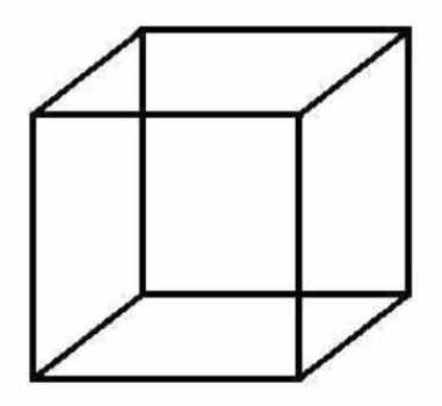
Figure Two: The Necker Cube
6. It could be argued that there will be
small energy changes in the individual concerned. Maybe so, but that response
itself has been subjected rebuttals advanced in
Note Four, above.
References
Engels, F. (1954),
Dialectics Of Nature
(Progress Publishers).
--------, (1976),
Anti-Dühring (Foreign
Languages Press).
Grossman, L. (2011), 'Neutrinos
Point To A New Reality', New Scientist 211, 2823, 01/10/11,
pp.7-9.
Hegel, G.
(1975),
Logic,
translated by William Wallace (Oxford University Press, 3rd
ed.).
--------, (1999),
Science Of Logic
(Humanity Books).
Lenin, V.
(1961),
Philosophical Notebooks, Collected
Works, Volume 38 (Progress Publishers).
Marx, K. and Engels,
F. (1975), Selected Correspondence
(Progress Publishers, 3rd ed.).
Plekhanov, G. (1956),
The Development Of The
Monist View Of History (Progress Publishers). This is reprinted in
Plekhanov (1974), pp.480-737.
--------, (1974), Selected Philosophical
Works, Volume One (Progress Publishers, 2nd
ed.).
Rees, J. (2008), 'Q Is For Quantity And Quality', Socialist
Review 330, November 2008, p.24.
Trotsky, L. (1971),
In Defense Of Marxism
(New
Park Publications).
Webb, R. (2011), 'Notorious
Big', New Scientist 210, 2808, 23/04/2011, pp.44-47. [The
on-line article has a different title.]
Woods, A., and Grant, T. (1995/2007),
Reason In Revolt. Marxism And
Modern Science (Wellred Publications 1st/2nd
edd.). [The on-line text still appears to be the first edition.]
Latest Update: 23/01/20
Word count: 19,940
Return To
The Main Index
Back To The Top
© Rosa Lichtenstein 2020
Hits Since 24/09/08: